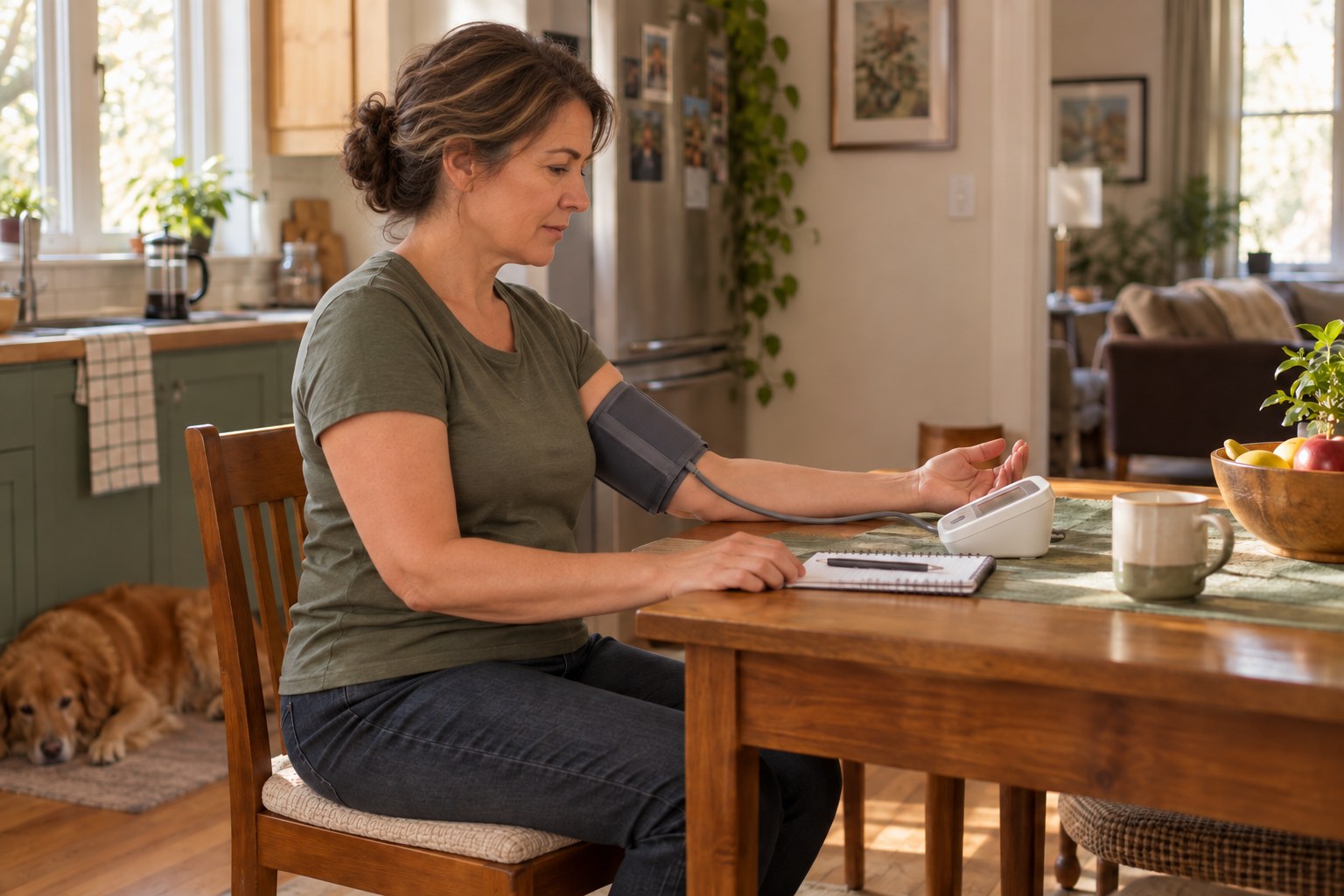
I used a home blood-pressure monitor for a while, and one thing kept bothering me: the lower number often looked higher than I expected.
Then I would measure again and get a different result.
That left me with a very ordinary question. Was the monitor inaccurate? Was I sitting wrong? Was I supposed to trust the first reading, the second one, or neither?
I cannot answer what caused my own readings from the numbers alone. But I can make the next set of readings more useful. The practical answer is to use the same careful setup each time, take two readings, record both, and bring the monitor and the log to a clinician if the pattern concerns me.
- Systolic pressure
- the top number. It is the pressure in the arteries when the heart contracts.
- Diastolic pressure
- the bottom number. It is the pressure in the arteries while the heart relaxes between beats.
- Validated monitor
- a device whose accuracy has been tested under a recognized validation protocol. “Cleared for sale” and “validated for accuracy” are not necessarily the same claim.
What does the bottom number mean?
The bottom blood-pressure number is called diastolic pressure. Seeing it higher than expected can feel especially confusing because most casual conversations focus on the top number. On the American Heart Association’s chart, a bottom number of 80–89 mm Hg falls in the Stage 1 range, and 90 or higher falls in the Stage 2 range, even when the top number is lower. Those categories are a reason to discuss a repeated pattern with a clinician, not a diagnosis from one home reading.
I cannot tell from those readings whether the monitor, my setup, or my blood pressure explains the difference. That is why I want a better record before drawing a conclusion.
What it can do is separate two questions:
- Did I measure as consistently as I could?
- What pattern should I show a qualified healthcare professional?
The second question becomes easier when the first one is handled well.
What Can Affect a Home Reading?
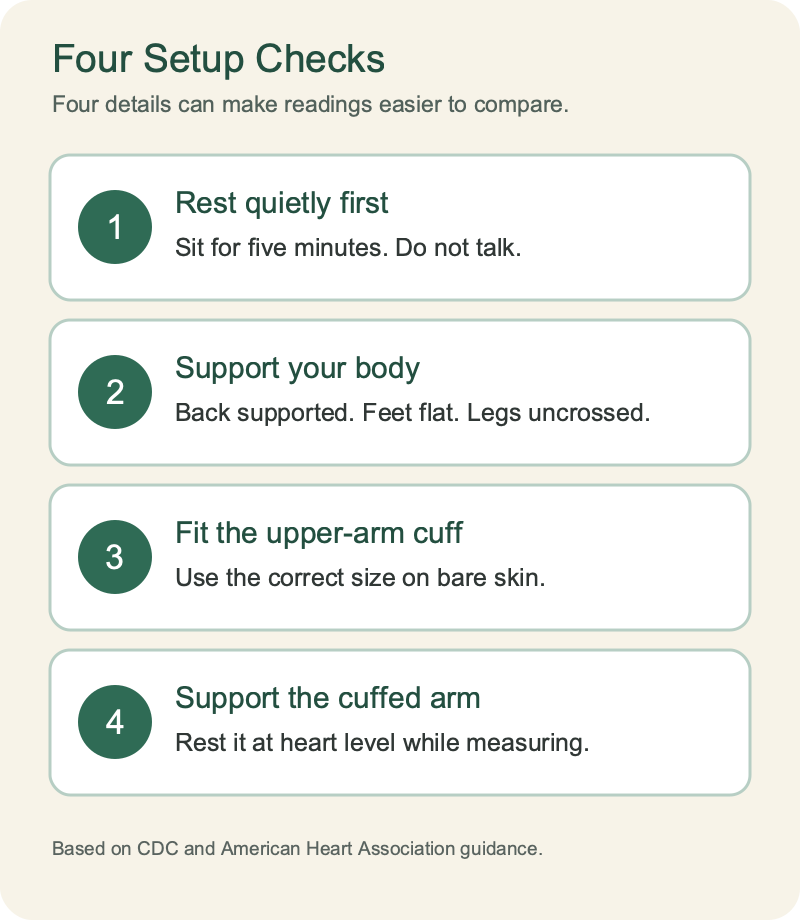
Position is only part of the setup. The CDC and American Heart Association also recommend avoiding food or drink, caffeine, alcohol, smoking, and exercise for 30 minutes beforehand, emptying the bladder, and measuring at a consistent time when possible.
Cuff fit deserves separate attention. The AHA recommends a validated automatic upper-arm monitor with the correct cuff size and suggests bringing the device to an appointment so it can be compared with office equipment.
Why can the next reading be different?
Blood pressure changes from moment to moment. The first measurement may also happen before I have fully settled into the chair. That makes “Why is my first blood-pressure reading higher?” a reasonable question—but not permission to delete the first number automatically.
Current CDC and AHA instructions recommend taking at least two readings, about one minute apart, and recording them. That is different from measuring over and over until a reassuring number appears.
If my first result is high and the next is lower, both numbers are information. Repeating the same standardized process over several days gives a clinician more context than one isolated reading or one hand-picked result.
Which readings should go in the log?
I would record both readings, the time, and the pulse if the device displays it. A brief note can explain unusual context—perhaps I had just climbed stairs before remembering the 30-minute pause, or I had not completed the five-minute rest.
The note is not there to explain away a result. It helps me reproduce the conditions next time.
What I would not do is keep checking until I found the number I wanted. That turns a record into a selection exercise.
What if home and office readings do not match?
Home and medical-office readings can differ. Rather than deciding that one location must be “right,” the AHA recommends taking the home monitor to an appointment. A healthcare professional can check the device, cuff fit, technique, and the pattern in the log.
The useful question is not simply, “Which reading should I trust?” It is, “Were these readings taken in a consistent way, and what does the complete pattern show?”
Do not stop or change blood-pressure medication based on a home reading without speaking with the prescribing clinician.
When a reading should not wait for a blog explanation
The AHA says that if the top number is higher than 180 or the bottom number is higher than 120 mm Hg, wait at least one minute and measure again. If it remains that high, contact a healthcare professional promptly. If a reading in that range occurs with symptoms such as chest pain, shortness of breath, back pain, numbness, weakness, vision changes, or difficulty speaking, call 911. Do not wait for it to come down on its own.
Those numbers and symptoms are not a home diagnosis. They are a reason to seek appropriate help.
What I changed about the question
I began with the bottom number. I wanted to know why it looked high.
I still cannot settle that question by blaming the machine or my posture. I can check my setup, keep both readings, and bring the record to someone qualified to interpret it.
I would rather show a clinician two readings I actually took than keep measuring until I get the number I hoped to see.
Sources
- Centers for Disease Control and Prevention, Measure Your Blood Pressure
- American Heart Association, Home Blood Pressure Monitoring
- American Heart Association, Understanding Blood Pressure Readings
- American Medical Association, US Blood Pressure Validated Device Listing
Leave a Reply