
For years, a continuous glucose monitor showed one changing number: glucose. A newly authorized wearable adds a second signal—ketones—and that second number needs a careful explanation.
On August 25, 2026, the U.S. Food and Drug Administration authorized the Libre Duo 10 Day for people age 2 and older who live with diabetes. The sensor measures glucose and ketones in fluid just under the skin and sends readings to a smartphone every minute.
It is the first continuous ketone monitor authorized in the United States and, according to the FDA, the first device worldwide to track both signals with one wearable.
This sounds like a two-for-one upgrade. It is more useful to think of it as two different questions being watched at the same time.
🩺 Quick glossary
A sugar in the blood that the body uses for energy.
Chemicals the liver makes when the body burns fat for energy.
Continuous glucose monitor, a wearable sensor that estimates glucose throughout the day and night.
Fluid surrounding the body’s cells. Wearable sensors measure this fluid rather than drawing blood continuously.
Diabetic ketoacidosis, a dangerous condition in which ketones build up and the blood becomes too acidic.
The short answer
Glucose tells you about sugar. Ketones tell you that the body is relying more heavily on fat for fuel. Ketones are not automatically an emergency; people can produce them during fasting, a low-carbohydrate diet, or exercise.
For someone with diabetes—especially when insulin is missing or not working well—rising ketones can also be an early warning of diabetic ketoacidosis. DKA is a medical emergency.
That is why the second number matters. It adds context that a glucose reading alone may not provide. It does not diagnose DKA by itself, and it should be interpreted with glucose, symptoms, and the person’s care plan.
Why people check ketones now
Today, many people check ketones only after something feels wrong or a glucose reading stays high. The usual tools are urine strips or a finger-stick blood ketone meter.
Those tests provide a snapshot. A continuous sensor can show direction: whether ketones are stable, rising, or falling between occasional checks. Libre Duo is designed to alert the wearer when ketones reach a concerning threshold.
The convenience is easy to understand. No extra strip at the exact moment someone is sick, traveling, sleeping, or already managing high glucose. But convenience should not be confused with a complete medical decision.
The FDA says ketone readings must be considered together with glucose levels and symptoms.

Two signals, two questions
Glucose asks
How much sugar is circulating right now?
Ketones ask
Is the body shifting toward fat as a major fuel source, and could that shift be becoming unsafe in this person’s situation?
One number does not translate neatly into the other. A person can have high glucose without dangerous ketones. Ketones can rise while glucose is not dramatically high, including in some people taking SGLT2 medicines. SGLT2 is a class of diabetes medicine that helps the kidneys remove glucose through urine.
The numbers are clues. Symptoms and context complete the picture.
What the FDA actually authorized
Libre Duo measures glucose and ketones in interstitial fluid every minute. The sensor sends information to a compatible smartphone and can be worn for up to 10 days.
The FDA reviewed six studies involving more than 600 participants. The agency used its De Novo pathway, which creates a new device category for a first-of-its-kind product with reasonable assurance of safety and effectiveness.
Authorization does not mean every person with diabetes needs this sensor. It means the device met the FDA’s requirements for its intended use. Access, insurance coverage, prescription practices, phone compatibility, and real-world cost are separate questions.
The question everyone will ask: What number is dangerous?
There is no responsible universal answer for an article to give you.
Ketone readings depend on the measurement method, symptoms, glucose, medicine, pregnancy, illness, and the instructions supplied by a clinician and the device. A continuous interstitial-fluid reading is also not identical to every blood or urine test people may have used before.
The safe preparation is to ask a care team in advance:
- What alert should make me check again?
- When should I use a backup blood or urine test?
- Which symptoms mean I should contact the care team?
- When should I seek emergency care?
- Could any medicine affect the warning pattern?
If someone with diabetes has symptoms of DKA—such as vomiting, abdominal pain, deep or rapid breathing, fruity-smelling breath, or severe tiredness—do not wait for an online tool to interpret the situation. Follow the person’s emergency plan and seek urgent medical help.
Try the two-number question guide
Open the situation you are preparing for. This guide does not diagnose DKA, score danger, recommend insulin, or replace urgent care.
A new device setup
- Which alerts should be on?
- When should I confirm with a backup test?
- Who should receive shared readings?
Illness or a sick-day plan
- What is the sick-day ketone plan?
- Which symptoms mean urgent help?
- When should I confirm with a backup test?
An unusual reading or alert
- Could sensor lag explain this pattern?
- When should I confirm the reading?
- Which symptoms change the response?
Exercise or a routine change
- What pattern is expected around exercise?
- When should activity stop?
- What supplies should stay nearby?
Travel
- How should supplies be packed?
- What is the time-zone plan?
- Where can urgent help be found?
A medicine change
- Can this medicine change ketone risk?
- Should alert settings change?
- What is the backup testing plan?
How it works: each heading expands three planning questions. Nothing is uploaded or stored. Use the list for a care conversation—not to interpret a current emergency.
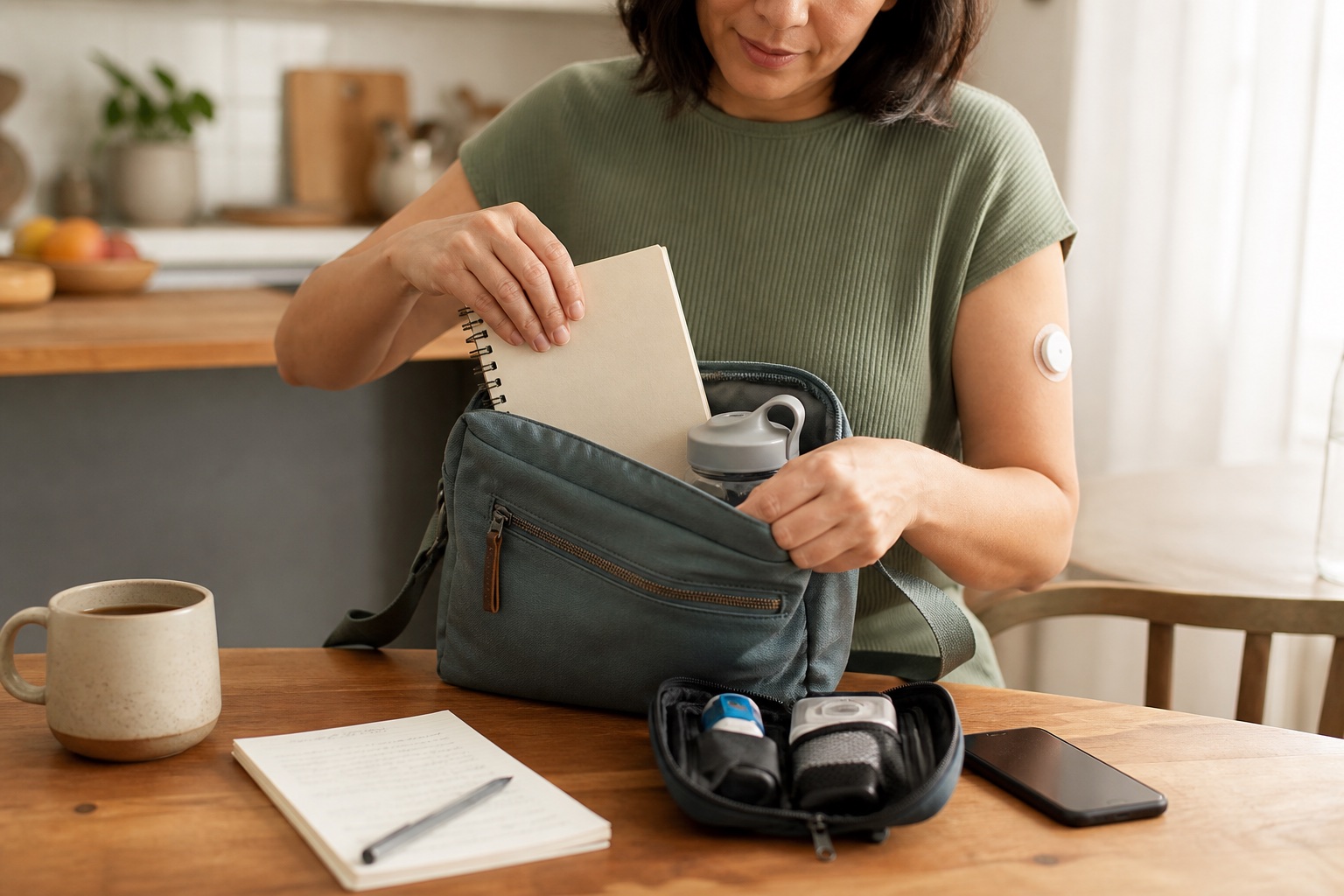
What could improve daily life
The strongest benefit may be fewer separate steps. One wearable can potentially reduce the need to remember another meter and another supply during moments when attention is already stretched.
Continuous context may also help a person notice a pattern sooner. That could be especially useful during illness, when an insulin pump or infusion set fails, or when food and insulin routines are disrupted.
Parents may appreciate the shared picture, too. A child’s glucose can look like the main story while ketones quietly add another clue. Still, more data can also mean more alerts and more anxiety. Alert settings and response plans matter.
What this device does not solve
It does not replace insulin, hydration guidance, a sick-day plan, a backup test when advised, or medical care. It does not make every ketone reading dangerous. It does not remove the small delay and measurement differences that come with sensing interstitial fluid.
And it does not answer the practical questions yet: what it will cost, who insurance will cover, how quickly clinicians will prescribe it, and how people will respond to two streams of alerts over months rather than days.
Those details will determine whether Libre Duo becomes a specialized safety tool or a common part of diabetes care.
The useful way to see the second number
The second number is not a verdict. It is context.
Glucose has long been the number people with diabetes are expected to watch, explain, and act on. Continuous ketone monitoring may reveal a developing risk earlier, but its value depends on understanding what the signal can and cannot say.
Before wearing a two-number sensor, the best first step is not memorizing someone else’s threshold. It is building your own response plan with the clinician who knows your diabetes.
Sources
- U.S. Food and Drug Administration, FDA Authorizes First Wearable Device That Continuously Monitors Both Ketone Levels and Blood Sugar, August 25, 2026.
- Centers for Disease Control and Prevention, Diabetic Ketoacidosis.
- U.S. Food and Drug Administration, SGLT2 inhibitor label warning on ketoacidosis.
- National Institute of Diabetes and Digestive and Kidney Diseases, Managing Diabetes.
Leave a Reply