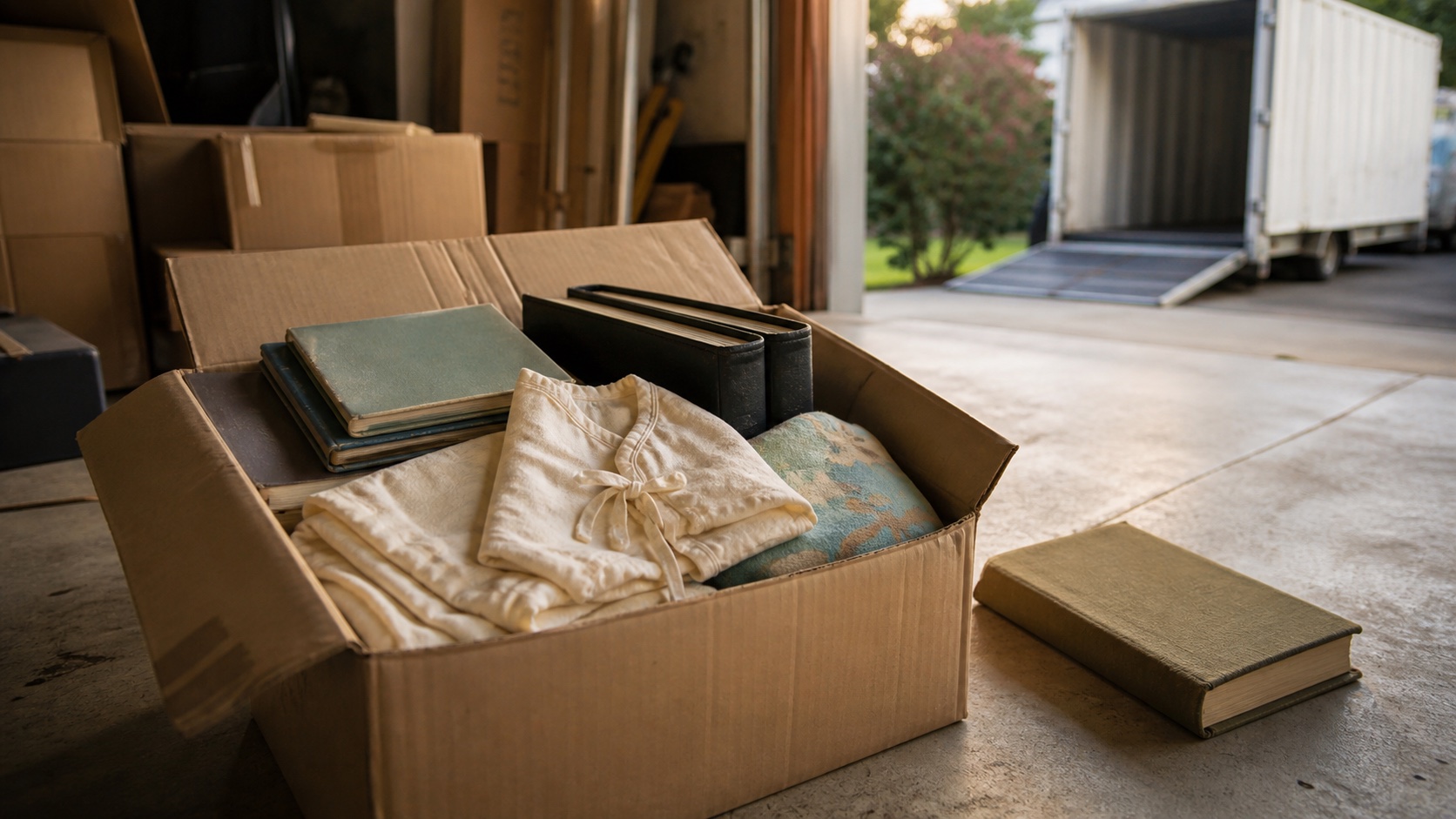
Most of my childhood was sitting in cardboard boxes in the garage.
I knew that because I had moved those boxes again and again. I rarely opened them.
Inside were several diaries from elementary school, two large binders of documents related to my parents, the small Korean baby jacket I wore as a newborn, and the blanket I had been attached to as a child.
After my parents died, my sister gathered everything for me. I brought it from Korea to the United States. Then the boxes followed me through one move, and another, and another.
For years, keeping them required almost no decision. They had a corner in the garage. That was enough.
Then I left California after living there for more than 20 years.
This time, everything had to fit inside a portable moving container. Sentiment had to compete with square footage.
The future visit I might be throwing away
Decluttering sentimental items sounds practical when the objects have not been used or even seen for years. I could honestly say I was not reading the diaries. I was not taking out the baby jacket or unfolding the blanket.
Still, when it was time to throw them away, I stopped.
What if I became much older and wanted to see them one more time? Would the handwriting of my elementary-school self feel funny, embarrassing, or unexpectedly precious? Would that tiny jacket make my own beginning feel real in a way that memory could not?
I was not using the objects. But I might have been saving a future meeting with them.
The moving container did not have room for every possible future.
So I took photographs and let most of the objects go.
At the time, that felt like a reasonable compromise. The physical things would be gone, but the images would remain.
Now I cannot find the photographs.
I do not know whether they are buried in an old phone backup, sitting in a cloud account, or mixed into thousands of other images. I only know that “I took a picture” did not make the memory as easy to revisit as I expected.
The one book I kept
I kept the family genealogy book.
It is not a record I use. I can no longer find which volume or page contains my own name, and the family line was not updated after my generation.
But it still feels different from the boxes I discarded.
I want my children to see what such a family record looks like—even if they only look at the outside and turn a few pages, even if the record stops before it reaches them. Its cover, binding, and pages say something that a missing photograph cannot.
Perhaps I did not keep it because it was complete.
I kept it so my children could hold the shape of a family story, even where the written line ends.
Leave a Reply