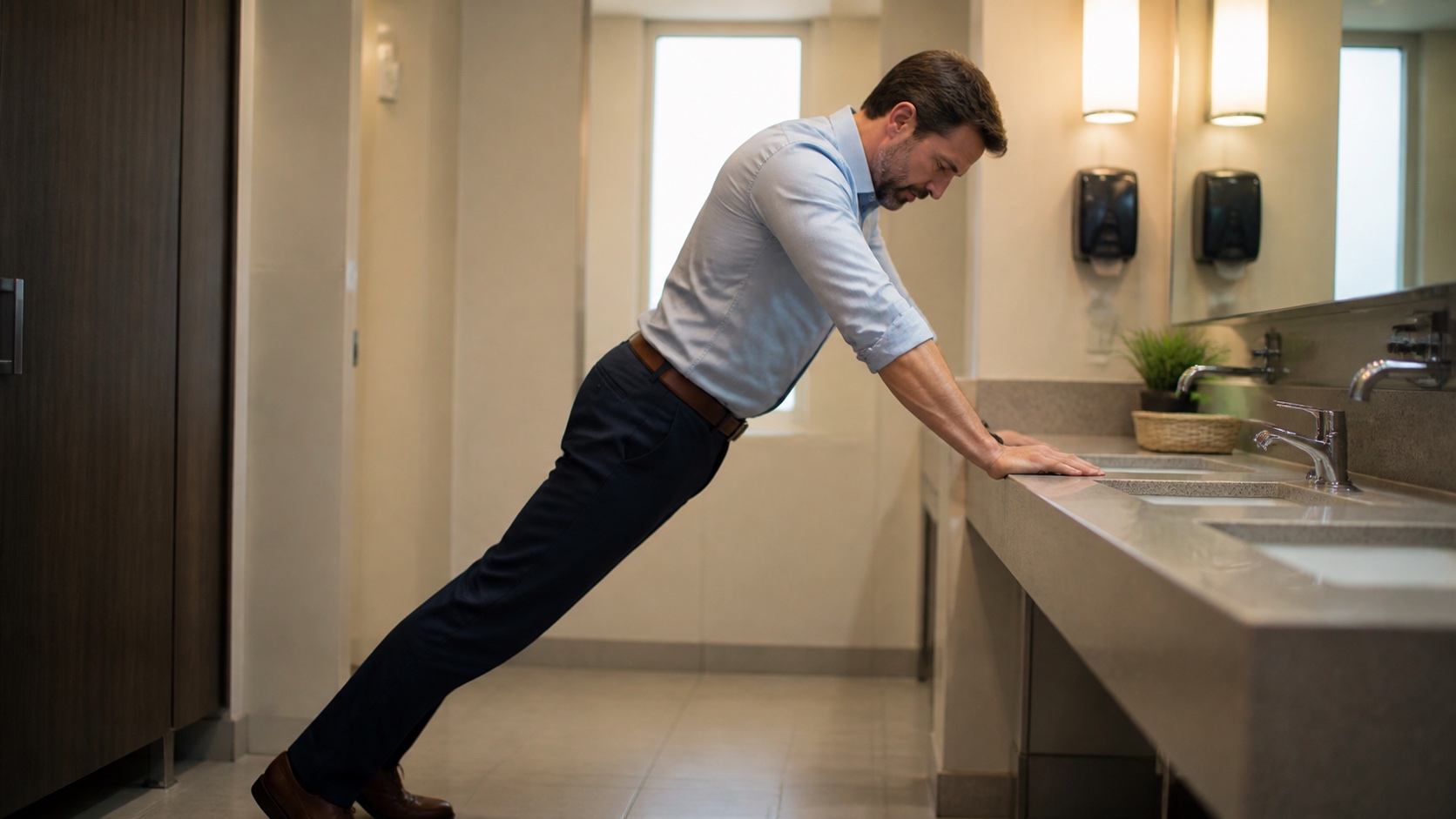
At work, a bathroom break sometimes has a second act.
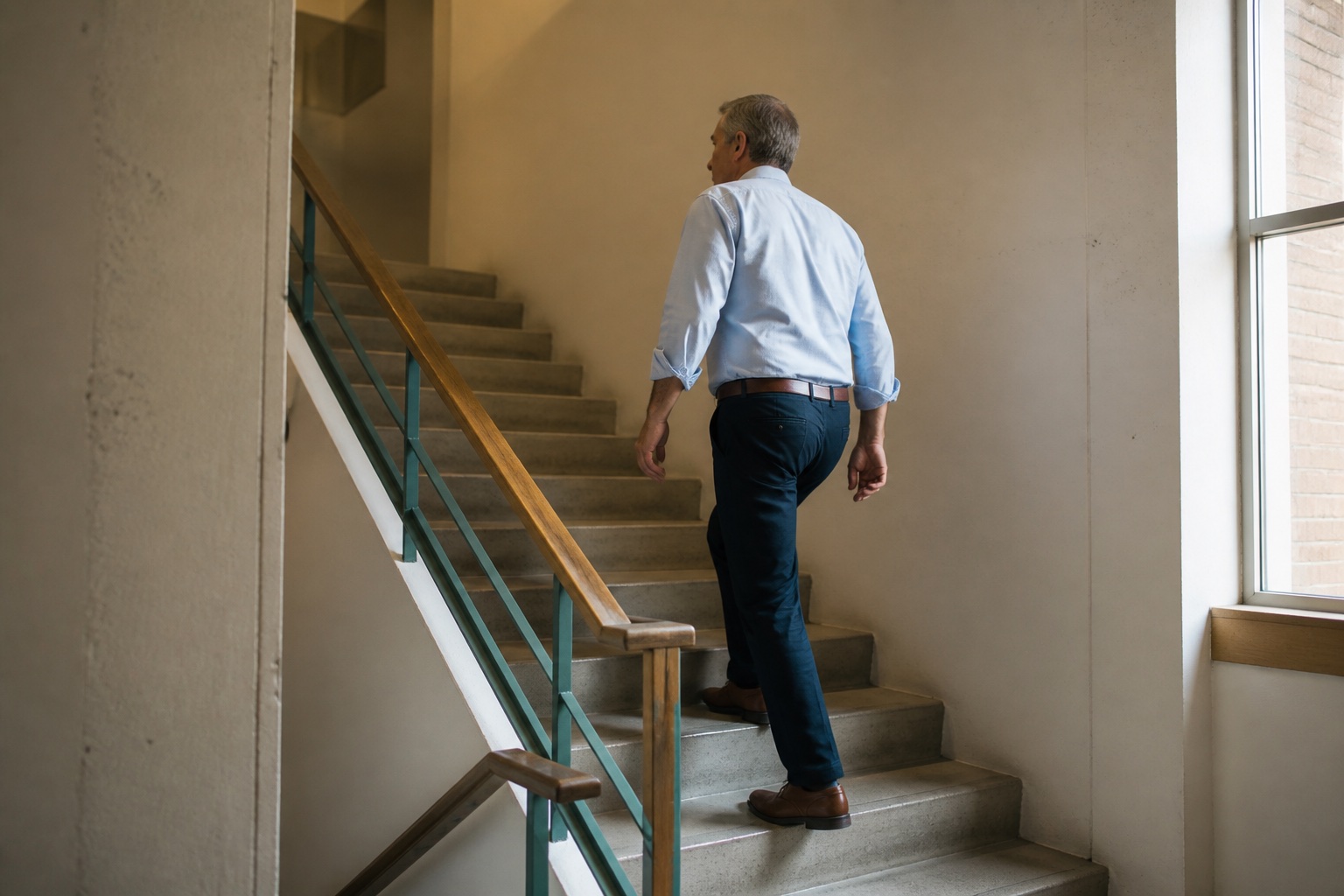
Before I leave, I put both hands on the sink and do 50 incline push-ups. I usually do that at least twice during the day. I also take the stairs—roughly 15 floors, two to four times—and at home I do bodyweight squats whenever the thought crosses my mind.
It sounds like a lot when I put all those repetitions in one paragraph.
But I had been asking the wrong question: How much exercise did I squeeze into the day? The better question was: Did I ask all the important muscles to do anything difficult?
That distinction matters for anyone worried about muscle loss after 50.
Quick glossary
Why muscle loss is bigger than appearance
The National Institute on Aging describes sarcopenia as a decline in muscle mass, strength, and function. It can show up as weakness, low energy, difficulty rising from a chair, slower walking, or trouble with stairs. Muscle mass and strength generally peak in early adulthood and then decline, although the rate varies widely from person to person.
That last part is encouraging. Age is not a command to become weak.
The same NIA overview calls resistance training the most important exercise component for building muscle and reducing muscle loss. Federal guidance also recommends a mix of aerobic activity, strengthening work for all major muscle groups, and balance activity—not one favorite move performed forever.
I did not need to abandon my small habits. I needed to audit them.
What my office routine actually trains
Sink push-ups: a real push, but still one direction
An incline push-up uses body weight as resistance. My hands are higher than my feet, so it is generally easier than a floor push-up. It trains a pushing pattern involving the chest, shoulders, and triceps, with some demand on the trunk.
Fifty repetitions can still feel like work. But if I can repeat the same version easily, adding more repetitions may be practicing endurance more than adding a new strength challenge. The CDC’s plain-language test is useful here: muscle-strengthening work should eventually make another repetition difficult without help.
That does not mean everyone needs to stop at a certain magic number. It means my count of 100 sounded more complete than it really was.
Stairs and squats: strong lower-body habits with overlap
Climbing stairs asks the legs and hips to move body weight upward while also raising breathing and heart rate. Bodyweight squats train a similar sit-down-and-stand-up pattern.
Both are useful. They also overlap.
Doing more of the same family of movement does not automatically fill what is missing elsewhere. My routine had plenty of pushing and knee-dominant leg work. I could not point to a regular pulling movement for my back. I was not deliberately training balance. I also had no clear way to tell whether the routine was becoming harder over time.
That was the first gap.
Clearly present
- Push: sink push-ups
- Squat or step: stairs and squats
- Aerobic effort: repeated stair climbing
Not clearly covered
- Pulling for the back
- A deliberate hip hinge
- Carry or core bracing
- Balance practice
- A progression rule
Then I tried creatine
I added creatine because I was worried about losing muscle. I took it for about six weeks.
Creatine is not muscle in a scoop, and it does not directly make a resting muscle grow. It helps replenish a rapid energy system used during repeated short, intense efforts. That is why the strongest case for it is usually as an addition to resistance training, not as a substitute for resistance training.
Reviews of trials in older adults suggest that creatine combined with resistance training can add modest gains in lean tissue or strength for some people. The results are not identical across every study or every person. The exercise remains the main event.
Is there a best time to take creatine?
The answer is less exciting than supplement marketing.
A randomized study comparing creatine taken within an hour before training with creatine taken within an hour after training found no meaningful timing advantage for the measured strength and body-composition outcomes. Other studies are small and do not establish a universal “anabolic window” for creatine.
In research protocols, regular use over time matters more than whether the scoop arrived at 7:45 or 8:45. That does not mean every person should take it daily—or at all. Kidney history, medications, diet, training, side effects, and personal goals change the decision.
The lab report that made me stop
After roughly six weeks, a routine blood report showed a higher creatinine result and a lower creatinine-based eGFR estimate than my earlier report. I stopped taking creatine as soon as I saw it.
My physician later called. When I explained that I had been using creatine, the physician said my kidneys were not bad and did not think I needed a separate follow-up test.
That was the decision in my case. It is not a rule for someone else’s report.
Creatine, creatinine, and eGFR are easy to mix up
Part of creatine metabolism ends in creatinine. Because many laboratories use blood creatinine to calculate eGFR, anything that changes creatinine can change the estimate—even when actual filtration has not changed by the same amount.
Creatine can enter a creatinine-based calculation
This is a measurement pathway—not proof of kidney injury or safety in one person.
Important: A changed creatinine-based estimate is not the same thing as a directly measured change in kidney filtration.
Sources: NIH Office of Dietary Supplements, NIDDK, and the 2026 de Souza Almeida et al. meta-analysis.
NIDDK explains that creatinine-based eGFR can be influenced by factors beyond kidney filtration, including muscle mass, diet, and certain medicines. When creatinine alone may give an incomplete picture, clinicians can consider context, trends, urine albumin, cystatin C, or other measurements.
A 2026 systematic review and meta-analysis found that creatine supplementation was associated with a small average increase in serum creatinine and a lower GFR when filtration was estimated from creatinine. It did not find a significant difference when filtration was assessed with a method independent of creatinine metabolism, and it found no significant differences in albuminuria or proteinuria. The authors concluded that the pattern likely reflected altered creatinine metabolism rather than kidney injury.
“Likely” matters. A supplement should not become an excuse to dismiss every abnormal result. It is information a clinician needs when interpreting the report.
I chose not to restart. I no longer felt that a separate supplement was necessary for the routine I wanted to build. That is different from saying creatine is unsafe, or that nobody else could benefit from it.
My routine needed coverage, not a bigger number
The most useful change was not finding a replacement powder. It was looking at movement patterns.
Here is the simple audit I now find more honest:
- Push: a wall, counter, sink, or floor push-up.
- Pull: a resistance-band row, cable row, or another controlled pulling movement.
- Squat or step: sitting and standing, squats, step-ups, or stairs.
- Hip hinge: a movement driven by the hips, such as a carefully learned deadlift pattern.
- Carry or brace: carrying an appropriate load or resisting trunk movement with control.
- Balance: a safe balance drill with support nearby when needed.
Movement Coverage Check
Think about the last seven days. Mark a pattern only if you deliberately practiced it at least once.
No boxes checked yet. The goal is to notice a missing pattern, not earn a fitness score.
This is not a sarcopenia test or workout prescription. It cannot judge difficulty, technique, pain, safety, or whether an exercise is appropriate for you. Nothing is stored or sent anywhere.
Static version: Review push, pull, squat/step, hip hinge, carry/brace, and balance. Ask which pattern was absent during your last seven days.
My routine had obvious marks beside push and squat/step. The other boxes forced better questions. Am I training my back? Does anything challenge my grip? Is the exercise harder than it was three months ago? Can I balance safely, or do I only count repetitions?
Protein, recovery, and progression still count
Muscle maintenance is not one supplement and one clever exercise cue.
Muscle needs a reason to adapt. That is the role of resistance training that gradually becomes more challenging. Muscle also needs enough energy, adequate protein, and recovery. Sleep and consistency are not glamorous, but neither is losing the ability to carry groceries or climb stairs.
I have already written a beginner guide to protein after 50. The important connection here is simple: eating more protein cannot make an unchallenged muscle stronger by itself, and training cannot build well if nutrition and recovery are chronically neglected.
What I am keeping—and what I am changing
I am keeping the sink push-ups. They are convenient, slightly ridiculous, and attached to something I already do. That makes them hard to forget.
I am keeping the stairs and the spontaneous squats too.
But I no longer treat a large repetition count as proof that my whole body is covered. I need a pulling movement. I need a clearer way to progress. I need balance and recovery to appear somewhere other than in an article draft.
That is the real lesson I took from trying creatine: I was looking for extra support before I had honestly mapped the routine it was supposed to support.
The better question is not “What else can I take?”
It is: Which movement have I quietly avoided?
Sources
- National Institute on Aging, How can strength training build healthier bodies as we age?
- Centers for Disease Control and Prevention, Older Adult Activity: An Overview
- NIH Office of Dietary Supplements, Dietary Supplements for Exercise and Athletic Performance
- National Institute of Diabetes and Digestive and Kidney Diseases, Clinical Measurements and eGFR Accuracy
- de Souza Almeida et al., Impact of creatine supplementation on kidney health: a systematic review and meta-analysis
- Dinan et al., Effects of creatine monohydrate timing on resistance training adaptations
- Chilibeck et al., Creatine during resistance training in older adults: systematic review and meta-analysis
Leave a Reply