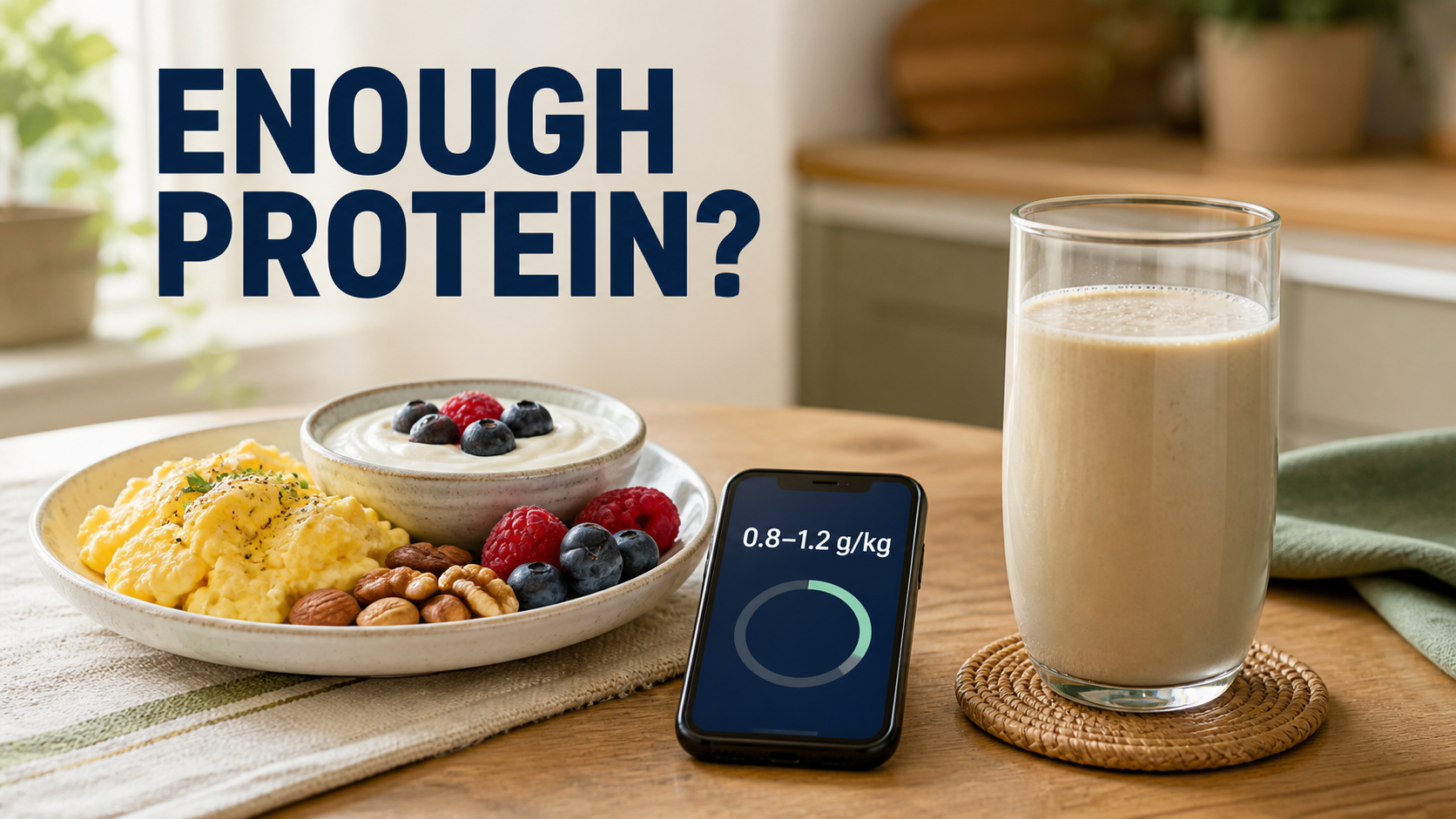
For a 150-pound adult, the numbers I found ranged from about 55 to 82 grams a day. That did not give me one perfect target, but it gave me a much better question to ask.
A protein drink makes the problem look easy. The carton says 20 grams, so drink one every day and move on.
I almost started there. Then I realized I did not know the more basic number: how much protein should a 150-pound adult be comparing those 20 grams against?
The first calculation gave me 55 grams. Another widely discussed range gave me 68 to 82 grams. That is a large enough difference that “eat more protein” stopped sounding like a complete answer.
I have not completed a normal week of food tracking yet, so this is not my final answer. It is the starting point I wish I had before looking at shakes.
THE SHORT ANSWER
The U.S. adult reference is 0.8 grams of protein per kilogram of body weight per day. For a 150-pound adult, that works out to about 55 grams. Expert groups studying healthy adults over 65 have proposed roughly 68–82 grams for the same body weight, usually alongside physical activity.
The U.S. Recommended Dietary Allowance is a general reference level designed to meet the needs of nearly all healthy adults—not necessarily a personalized target for preserving the most muscle possible with age.
For healthy adults older than 65, several expert groups have proposed approximately 1.0 to 1.2 grams per kilogram per day, combined with physical activity. These are expert recommendations based on aging research, not a new official U.S. RDA and not an automatic prescription for everyone over 50.
Turning 50 does not flip a biological switch. Body size, usual diet, activity, health conditions, weight changes, and recovery needs all affect the practical answer.
A simple calculation
INTERACTIVE TOOL
Protein Calculator: Estimate Your Daily Reference Range
Enter a weight in pounds to convert it to kilograms and compare three commonly discussed protein reference levels.
These are educational reference calculations, not a personalized protein prescription. Individual needs can differ with age, activity, health conditions, and recovery needs.
First, convert body weight from pounds to kilograms:
Body weight in pounds ÷ 2.2 = body weight in kilograms
Then multiply that number by the reference level being considered.
For someone weighing 150 pounds:
- 150 ÷ 2.2 = approximately 68 kilograms
- At 0.8 g/kg: approximately 55 grams per day
- At 1.0 g/kg: approximately 68 grams per day
- At 1.2 g/kg: approximately 82 grams per day
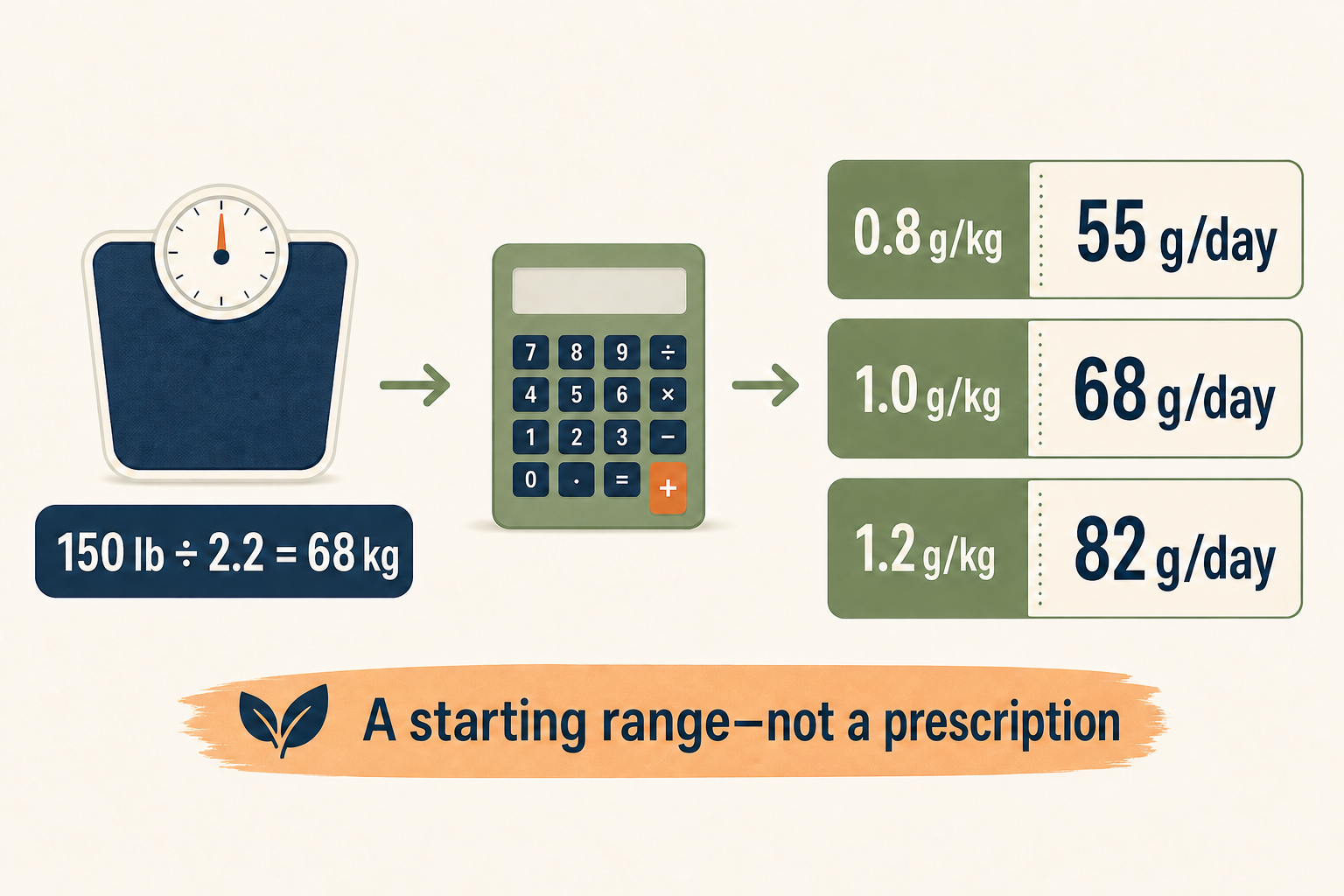
So the calculation did not tell me to begin eating 82 grams tomorrow. It gave me three numbers I could compare with an ordinary day of food. That is already more useful than guessing.
Why protein receives more attention with age
Muscle mass and strength tend to decline as people get older. Protein supplies amino acids used to maintain and repair muscle, but protein alone is not a complete muscle-preservation strategy.
The current U.S. Dietary Guidelines note that some older adults need fewer calories while still requiring as much or more of key nutrients such as protein. They emphasize nutrient-dense sources rather than relying on one product: seafood, eggs, dairy, legumes, nuts, seeds, and other whole foods can all contribute.
Expert groups studying adults over 65 commonly pair their higher protein suggestions with resistance exercise and regular physical activity. That pairing is important. Adding protein while remaining inactive is not equivalent to challenging the muscles and giving the body adequate material for recovery.
My next step is not buying another shake
My next step is less interesting than shopping: write down what I normally eat for two or three days without first trying to improve it.
WHAT I AM CHECKING
- The food and approximate serving size
- Protein shown on the package or in a reliable nutrition database
- The meal subtotal
- The daily total
The total is useful, but I also want to see where it comes from. If breakfast and lunch contain very little protein and dinner carries almost the entire day, that is a different problem from simply eating too little overall.
Here is an example—not my completed food log:
| Meal | Example foods | Approximate protein |
|---|---|---|
| Breakfast | Two eggs and a cup of milk | 20 g |
| Lunch | Lentil soup and Greek yogurt | 25 g |
| Dinner | Chicken, rice, and vegetables | 35 g |
| Snack | A small handful of nuts | 5 g |
| Total | 85 g |
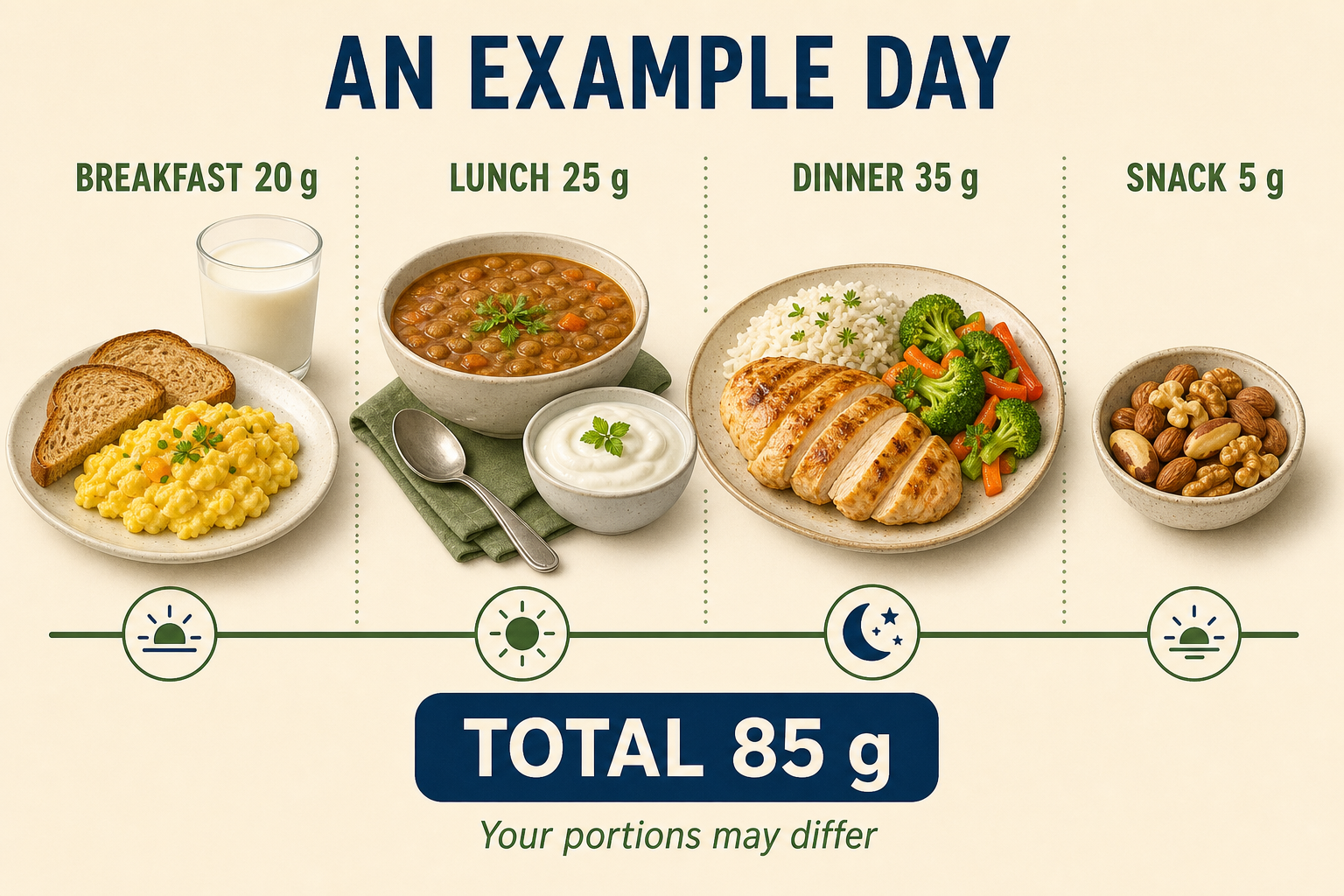
Real portions will change every number in that table. That is why I do not want to mistake a neat example for evidence about my own diet.
Where a protein shake can help
A protein shake is a convenience food, not proof that a diet is healthier.
It can be useful when someone consistently falls short, has little appetite, needs a portable breakfast, or finds it difficult to prepare an adequate meal. A product providing 20 grams could close a real gap if tracking shows that breakfast regularly contains almost no protein.
But if ordinary meals already meet the intended range, the shake may simply add calories and cost. The complete label matters—not just the large protein number on the front.
WHAT I WOULD CHECK ON THE LABEL
- Calories per serving
- Added sugar
- Sodium
- Protein source
- Fiber
- Sweeteners and ingredients that affect digestion
- Vitamins and minerals that may duplicate other supplements
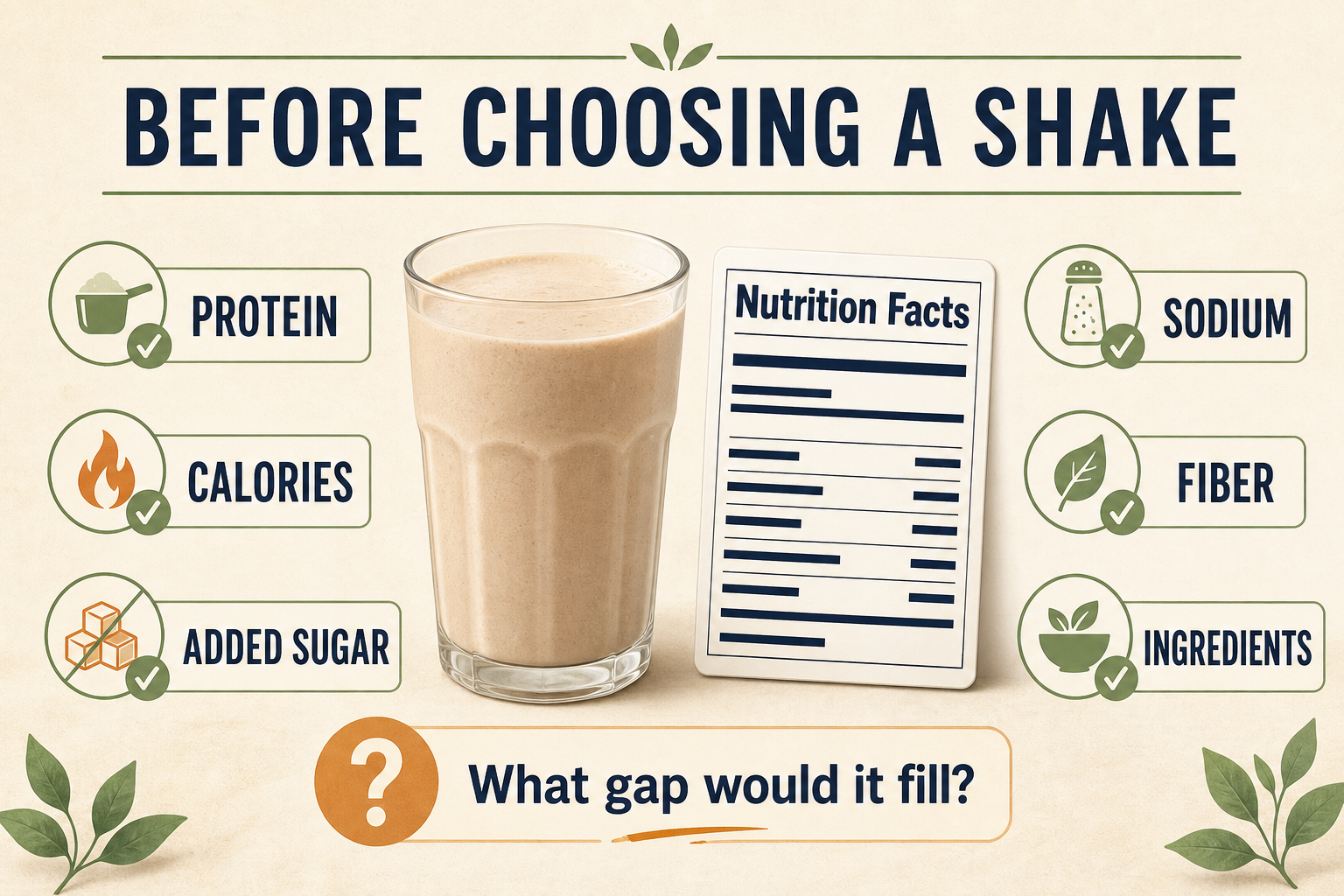
For now, my question is not “Is this shake healthy?” It is “What gap would it fill?” If I cannot answer that, I am judging the package rather than my diet.
More is not automatically better
Protein discussions sometimes move too quickly from “enough is important” to “more must be better.” Evidence does not justify treating the highest number online as a goal for everyone.
CHECK FIRST
Higher protein intake may be inappropriate for some people with kidney disease or other conditions. Acute illness, unintended weight loss, recovery from injury, and malnutrition require individualized guidance—not a general blog calculation.
Food quality matters too. Increasing protein entirely through highly processed meat would have a different nutritional effect from using a mix of fish, yogurt, beans, lentils, tofu, eggs, nuts, and lean meat. Protein is one part of the diet, not a reason to ignore fiber, vegetables, healthy fats, or total calories.
What I am actually going to do
- Calculate the 0.8 g/kg adult reference amount.
- Track two or three ordinary days without deliberately changing them.
- Find the weakest meal and the easiest food-based improvement.
- Keep the 1.0–1.2 g/kg research range in context instead of treating it as a rule that begins at 50.
- Treat resistance exercise as part of the question, not as a footnote to protein.
- Use a shake only when it solves a demonstrated convenience or intake problem.
- Ask a clinician or registered dietitian before deliberately increasing protein if kidney function or another medical issue is a concern.
It is not a dramatic plan. But it should tell me whether I have a real protein gap, which meal creates it, and whether a shake would solve it conveniently.
What I want to examine next
Daily quantity is only the first question. Next I want to look more closely at protein across meals. Is my breakfast the weak point? Would ordinary food fix it? And if I use a shake, what exactly am I getting besides the protein number on the front?
I am not trying to win a protein contest. I am trying to stop guessing.
This article is for general education and documents an ongoing learning process. It is not medical or individualized nutrition advice.
Sources
- National Academies: adult protein RDA of 0.8 g/kg/day
- Dietary Guidelines for Americans, 2025–2030: guidance for older adults
- ESPEN Expert Group: protein intake and exercise for muscle function with aging
- ESPEN practical guideline: clinical nutrition and hydration in geriatrics
Research reviewed: August 22, 2026.
Leave a Reply