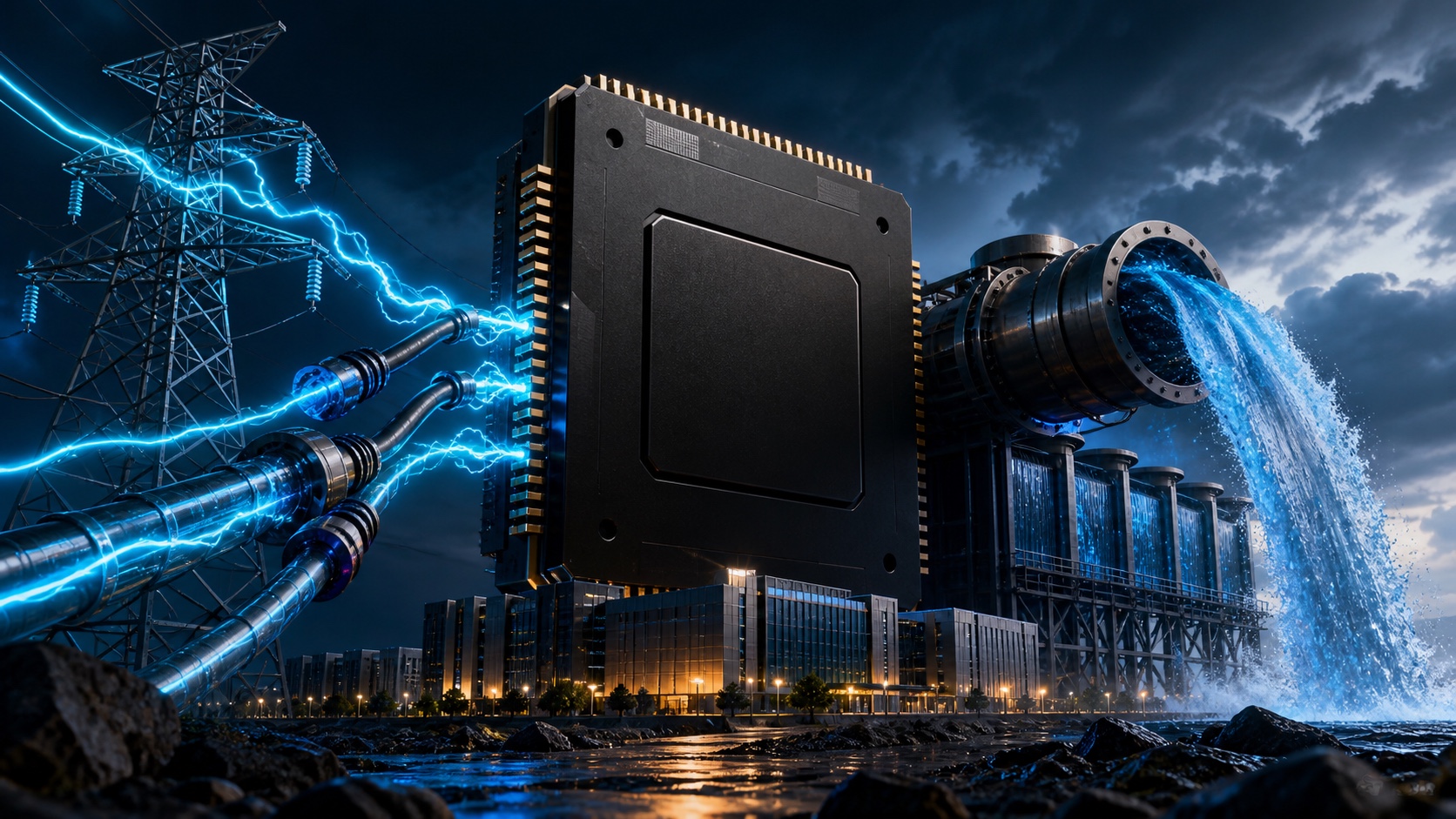
When people talk about the AI race, they usually talk about chips. Faster chips. Scarce chips. Who can buy the most chips.
But every one of those chips sits in a building, draws electricity, and throws off heat. At some point, the race leaves Silicon Valley and arrives at a substation, a reservoir, or a utility hearing near somebody’s home.
That is the part of the AI boom worth understanding. The numbers are enormous, but their effects are stubbornly local.
One power request can be enormous
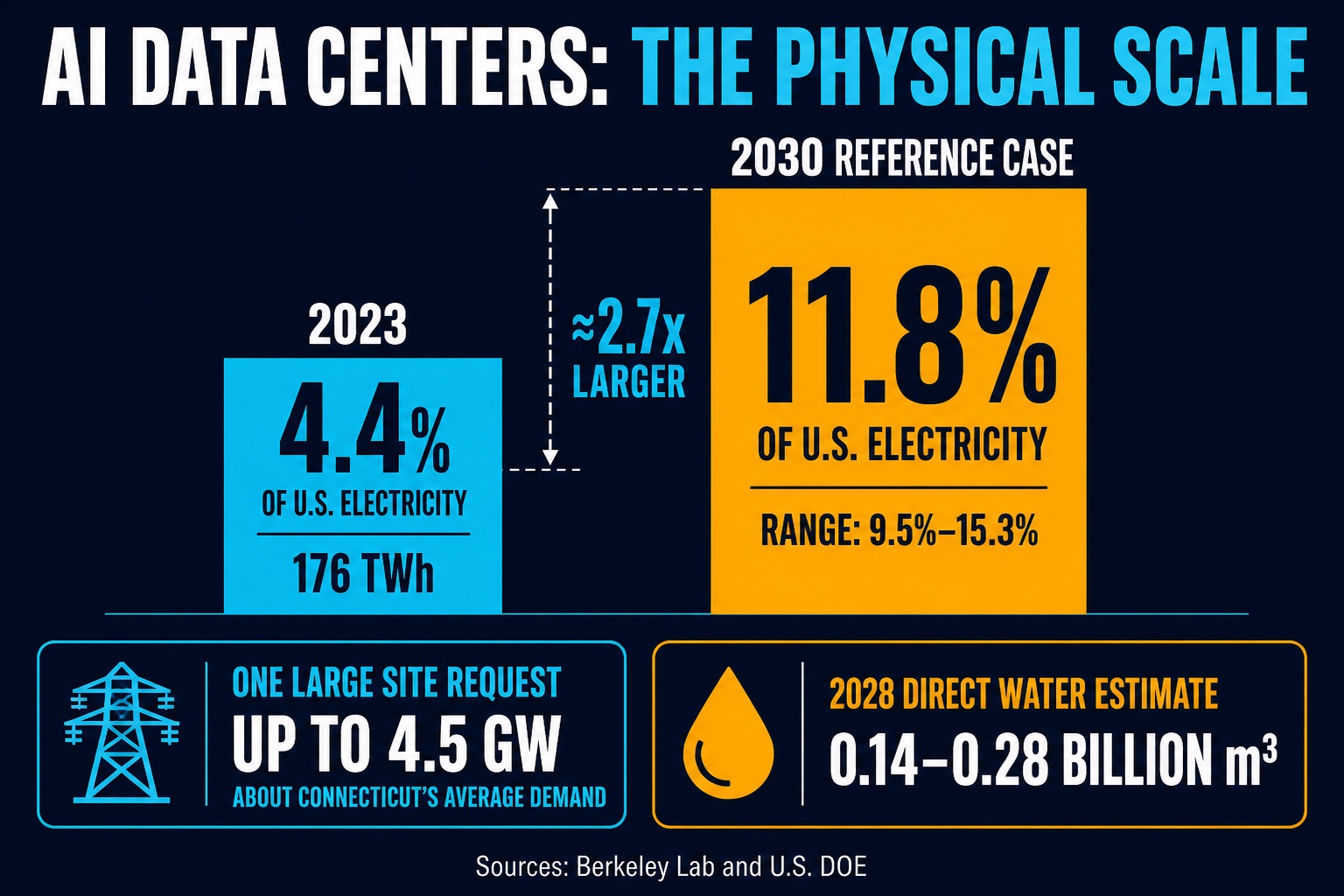
The U.S. Department of Energy says individual large sites have requested as much as 4.5 gigawatts of power capacity. DOE compares that with the average electricity demand of the entire state of Connecticut.
One site. One state’s average demand.
That does not mean every proposed facility will use 4.5 gigawatts. It does show why utilities cannot treat the largest AI data centers like another office building joining the grid.
Berkeley Lab’s latest update puts the national picture in equally blunt terms. Its reference case estimates that data centers could use 11.8% of all U.S. electricity in 2030. Depending on how equipment, cooling, and operations develop, its modeled range is 9.5% to 15.3%.
Those are projections, not a scheduled outcome. Still, compare them with 2023: data centers used about 176 terawatt-hours, or 4.4% of U.S. electricity. Even the low scenario points to a sharp change in only a few years.
Electricity goes in. Heat has to come out.
This is where water enters the story.
Servers turn nearly all the electricity they use into heat. A data center has to move that heat away, hour after hour. Some facilities use evaporative cooling and consume water on site. Others rely more on air, closed loops, or hybrid designs. Producing the electricity can have its own water footprint too.
So “How much water does AI use?” has no honest one-number answer. Climate matters. Cooling design matters. The local power mix matters. Even the time of year matters.
Berkeley Lab estimated that U.S. data centers could directly consume roughly 0.14 to 0.28 billion cubic meters of water in 2028. The range is wide for a reason. A facility using reclaimed water in a cool region is a different local proposition from one drawing drinking water during a hot, dry summer.
This is also why national totals can hide the hardest part. Water stress happens locally.
The grid problem is partly a clock problem
It is tempting to ask, “Does America have enough electricity?” That question is too broad.
Power has to reach a particular place at the moment it is needed. A region may have enough annual generation and still lack a transmission line, substation, or transformer for a new round-the-clock load. Building that equipment can take years. A data center developer may want to open much sooner.
That timing mismatch is the real pressure point.
New generation, batteries, microgrids, and flexible demand could help. Better cooling and more efficient chips could help too. But “could” is doing important work in that sentence. Benefits depend on actual contracts and operating rules. A promise to support the grid is not the same as an enforceable plan to do it.
What happens to everyone else’s bill?
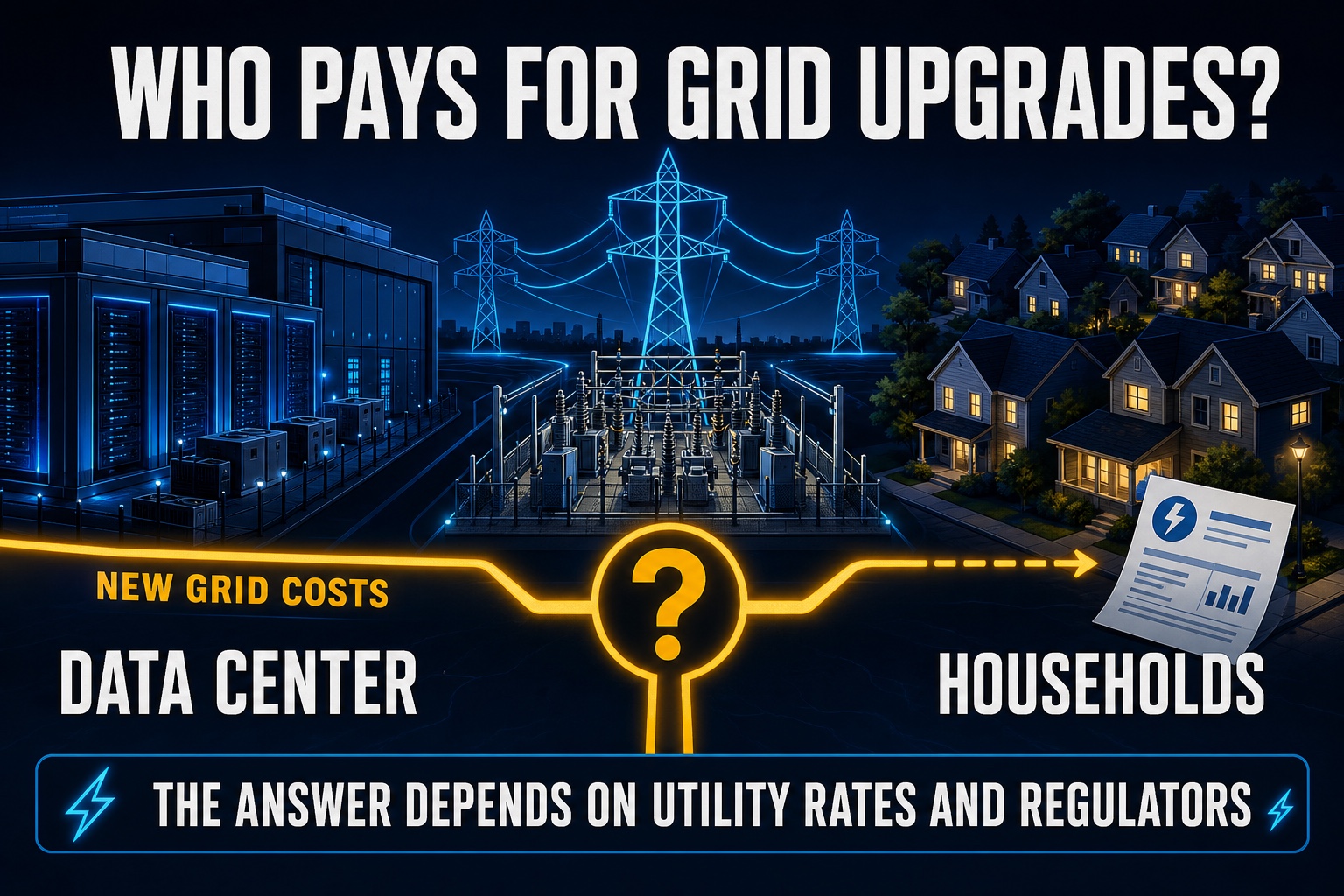
One question kept appearing in public discussions, and it deserves a careful answer: a large data center can add major system costs, but it does not automatically raise every household’s bill.
Someone must pay for new substations, transmission, generation, and backup capacity. The data center may pay through a special rate or fund dedicated upgrades. Some costs may be shared. Regulators can also require protections if a planned facility never reaches the demand it forecast.
Details decide the outcome. That makes the rate agreement more useful than either side’s slogan.
If a project is proposed nearby, start with three questions:
- What are its peak electricity and hottest-day water needs—not only annual averages?
- Which upgrades will it require, and exactly who pays if demand rises, falls, or never appears?
- Which efficiency, water, clean-power, or demand-flexibility promises are binding and publicly reported?
Jobs and investment belong in the discussion. So do land, noise, water, emissions, and financial risk. None should be hidden behind the word “innovation.”
AI may feel virtual. Its limits are not.
AI arrives on a screen as a few lines of text or a generated image. Nothing about that experience looks like a transmission project. Yet behind the screen are buildings that need enormous, reliable flows of power and a way to dispose of enormous amounts of heat.
This is not an argument to stop building AI infrastructure. It is an argument to stop treating infrastructure as a footnote.
The next AI breakthrough may happen inside a model. Whether millions of people can use it may depend on a transformer, a cooling system, and a public agreement most of us will never see.
Leave a Reply