
You probably know the post before you finish its second sentence.
Someone missed a flight. By the time the plane took off, the delay had produced seven leadership lessons, a new philosophy of resilience, and one final question: “Agree?”
It reads smoothly. Maybe too smoothly. The details never quite arrive.
LinkedIn now gives readers a way to register that suspicion. Open the three-dot menu beside a post or comment and you may see “Seems like AI slop.” More than one million members used the option in its first two weeks, according to a LinkedIn update reported by Social Media Today.
Short answer
As a feedback button, yes. As an AI detector or instant punishment, no. That gap is where this story gets interesting.
What happens after someone clicks it?
Despite the ominous name, this is not a digital trapdoor. One click does not delete a post, prove that a chatbot wrote it, or automatically crush the writer’s reach.
LinkedIn describes member feedback as one of many signals used to shape recommendations. The company can combine that signal with its own analysis of generic or repetitive posts, particularly when deciding what to push beyond a person’s immediate network.
In practical terms, the click says something closer to, “I found this polished but empty.” LinkedIn then decides what, if anything, to do with that information.
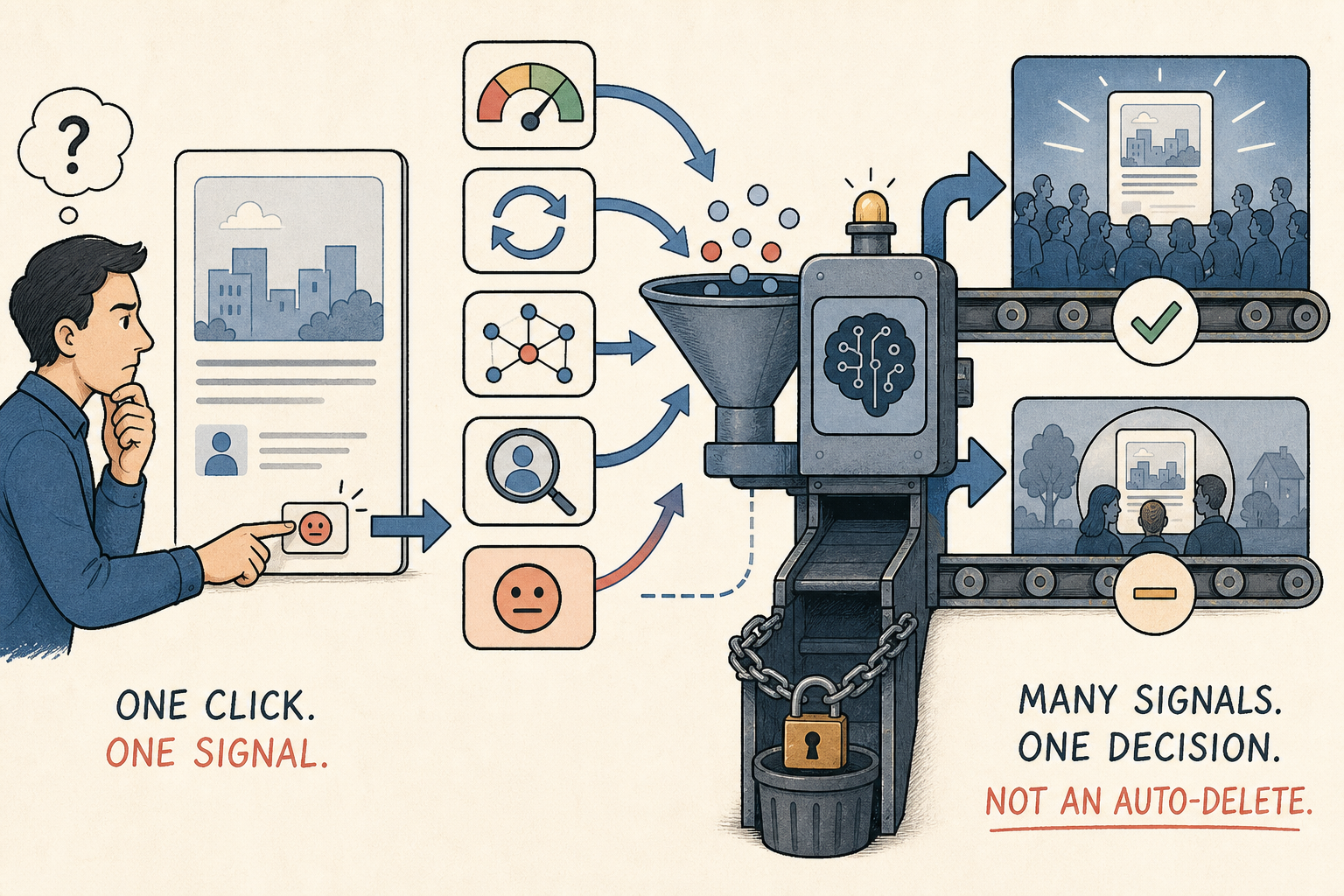
That restraint is necessary. Otherwise, every unpopular opinion, awkward translation, and enthusiastic user of em dashes would be one annoyed reader away from an AI conviction.
“Polished but empty” is a better definition
Trying to identify AI by punctuation or sentence style quickly turns silly. LinkedIn’s own description focuses on value: low-effort, AI-generated material that appears polished but lacks a distinct perspective or substance.
The company also points to mass-produced comments and replies that merely restate the original post. Those are familiar sights: “Great insights, Sarah! This really highlights the importance of authentic leadership.” The comment is friendly, grammatical, and almost completely unnecessary.
Other warning signs are just as ordinary:
- a supposedly personal story without one believable detail;
- advice that fits every workplace and helps with none;
- twenty short paragraphs marching toward “consistency is key”;
- a confident claim with no source, example, or visible cost.
These clues do not prove AI wrote anything. Human beings invented empty business prose. Generative AI gave it night-shift workers.
LinkedIn has an awkward role in this mess
LinkedIn offers generative-AI features, too. Its user agreement warns that generated material can be inaccurate, incomplete, or misleading and tells members to review it before posting.
That leaves the platform in a strange position. It makes professional-sounding language easier to produce, then recruits readers to flag the moments when that language becomes unbearable.
The contradiction is real, but “never use AI” would be a poor lesson. A person might use a tool to trim a rambling draft, translate a post, or fix grammar while keeping the underlying observation intact. Someone else can type every word by hand and still produce six paragraphs of reheated management fog.
What disappeared from the post matters more than which tool touched it. Was there a real experience? A decision? A detail that could not have come from just anyone?
About that 94% detection figure
LinkedIn says its systems look for generic or repetitive material and whether a post adds perspective, context, or expertise. In initial testing, the company reported correctly identifying generic content 94% of the time.
That is a specific and promising test result. It is not evidence that LinkedIn can reliably determine who used AI, and it does not tell us how the system will behave across every language, profession, or writing style.
The edge cases are not hard to imagine. A careful human writer can sound generic. A heavily edited AI draft can include real experience. A person writing in a second language may use software to express an original idea more clearly. Report buttons can also attract people who simply dislike the writer.

This is why the wording “Seems like AI slop” is more honest than “Generated by AI.” The first records a reader’s judgment. The second pretends to know the production history.
Three questions beat guessing who used AI
Readers do not need to become amateur forensic linguists. A simpler check is more useful:
- What did I learn that is specific? Look for a decision, number, example, source, or consequence.
- Could anyone have posted this? If the author’s name and industry can be swapped without changing the message, little perspective made it onto the page.
- Is the confidence earned? Strong advice needs evidence, experience, or an honest limit.
Writers can make the same check from the other side. Remove the formatting, the inspirational closer, and the rocket emoji. Is there still a thought worth another person’s time?
Try the LinkedIn AI Slop Check
Check every sign you notice. This scores generic, low-value writing—not who or what typed it.
For entertainment and writing improvement. It cannot determine whether AI wrote a post.
How does this work?
This is a lightweight writing checklist—not an AI detector, lie detector, or scientific instrument.
It counts common signs of generic writing: missing specifics, recycled advice, unsupported confidence, predictable formatting, and empty engagement hooks. Humans can write all of these too.
The score is meant for reflection and mild amusement. Do not use it to accuse a writer, evaluate an employee, or start a LinkedIn investigation. When uncertain, judge the usefulness of the post—not who or what typed it.
The million clicks matter, even if the button is imperfect
One million uses do not mean one million accurate identifications. Nor do they show, by themselves, that LinkedIn’s feed has improved. They show that a large number of users recognized the label and wanted to use it.
For years, social platforms rewarded volume, smoothness, and constant activity. Generative AI supplied all three so efficiently that smoothness began to lose its value. The scarce item now is a sign that somebody noticed something before posting it.
LinkedIn will use classifiers, feedback signals, and recommendation systems to look for that sign. Readers can use a less technical test:
After all those polished sentences, was there a person with something to say?
Leave a Reply