
The forecast is getting attention. The number that reaches your bank account is the more useful one.
COLA stands for Cost-of-Living Adjustment. It is the yearly percentage Social Security uses to help benefits keep up when everyday prices rise. Think of it as an inflation adjustment—not a bonus.
Here is a simple example: if someone receives $1,000 per month and the COLA is 3.6%, the gross benefit (before deductions) would rise by $36 to $1,036.
- COLA
- Cost-of-Living Adjustment—the yearly Social Security percentage intended to help benefits keep up with rising prices.
- CPI
- Consumer Price Index—a group of government measurements that track how prices change over time.
- CPI-W
- Consumer Price Index for Urban Wage Earners and Clerical Workers—the specific version of CPI used to calculate Social Security COLA.
- Gross benefit
- The benefit amount before Medicare premiums or other deductions are taken out.
- Medicare Part B
- Medical coverage that helps pay for doctor visits, outpatient care, and certain other services. Many people have its premium deducted from Social Security.
The latest widely cited 2027 Social Security COLA prediction is 3.6%. On the average retired-worker benefit reported for July 2026, that would work out to roughly $75 more per month.
That is the cheerful version.
The less tidy version is that 3.6% is still a forecast, two important inflation readings are missing, and a higher Medicare premium could take a bite out of the increase before it reaches many retirees.
So the question is not only, “What will the 2027 COLA be?”
It is also: What might actually change in the monthly deposit?
First, 3.6% is not official
The Senior Citizens League estimated a 3.6% COLA after the July inflation report. Its forecast had been 3.8% a month earlier, which is a useful reminder that these numbers move.
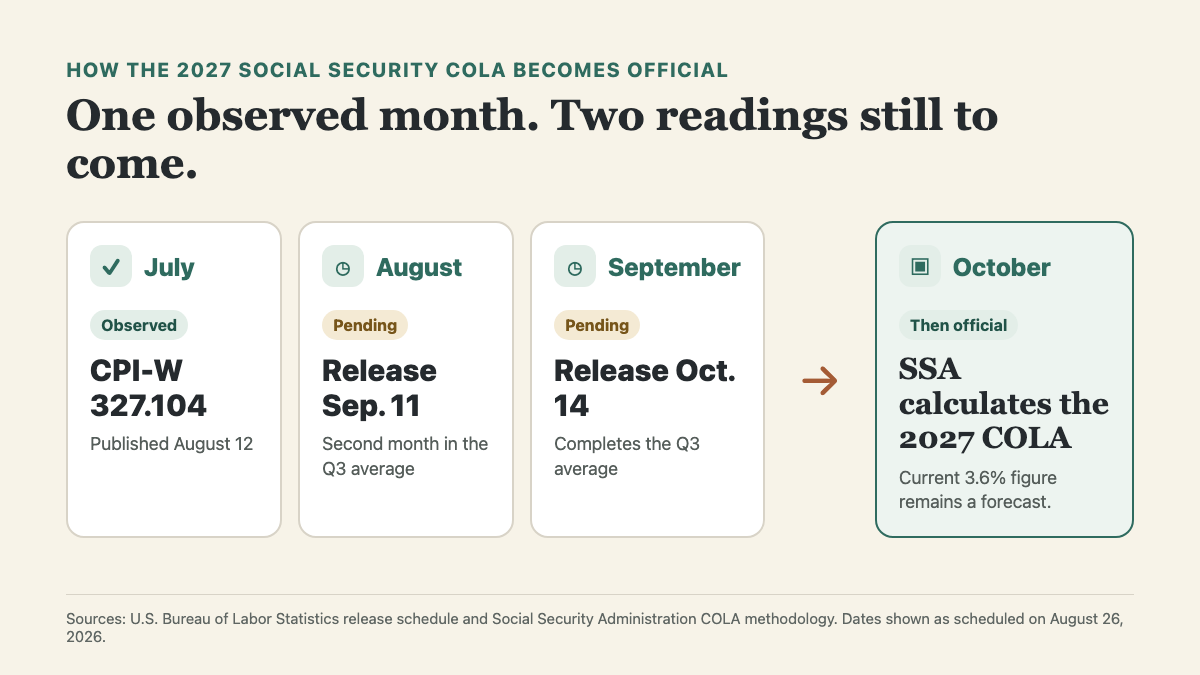
Social Security does not simply use the July inflation rate—the percentage showing how much prices changed from a year earlier. CPI stands for Consumer Price Index. It is a family of government measurements that follows changes in consumer prices. CPI-W is one version of CPI, focused on urban wage earners and clerical workers, and federal law uses that version to calculate Social Security COLA. Social Security compares the average CPI-W for July, August, and September 2026 with the average for the same three months in 2025. The Social Security Administration explains that method on its COLA information page.
We have July. We do not yet have the full three-month average.
The Bureau of Labor Statistics reported that July’s CPI-W was 327.104, up 3.4% from a year earlier. August data are scheduled for September, and the final September reading will allow the official COLA calculation in October.
In other words, 3.6% is a reasonable current estimate—not a promise printed on next year’s check.
What 3.6% would mean in dollars
The Social Security Administration’s July 2026 statistical snapshot lists the average retired-worker benefit at $2,085.98 per month.
Apply 3.6% to that amount and the illustration looks like this:
- Current monthly benefit: $2,085.98
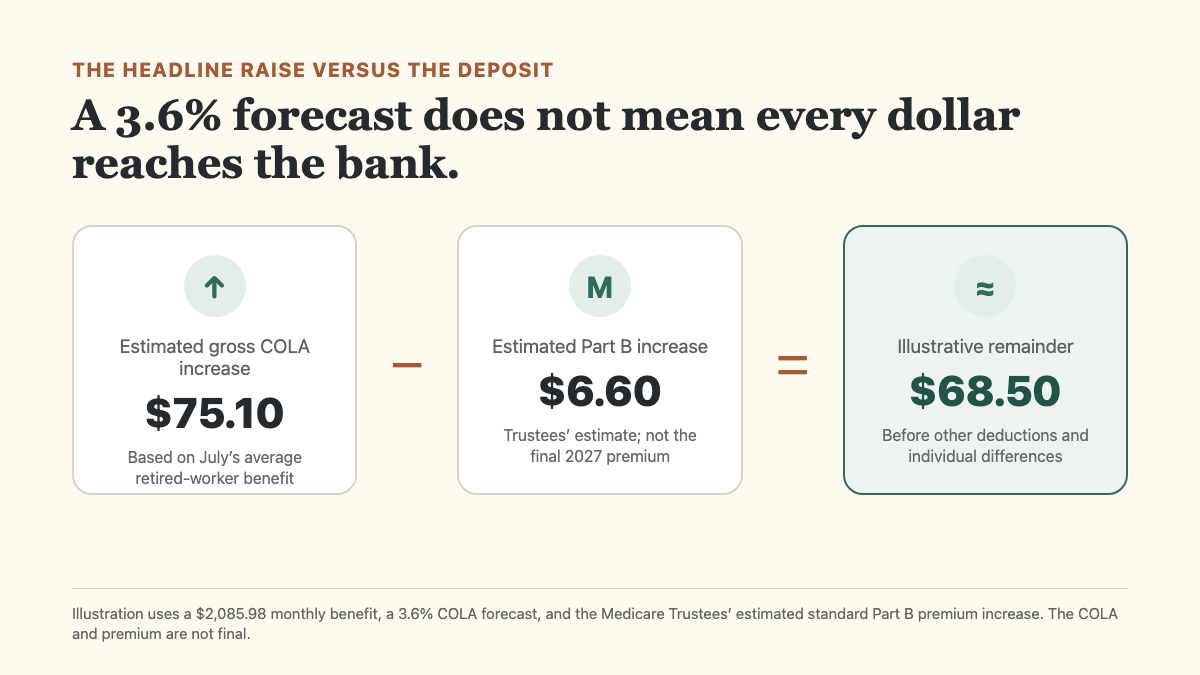
- Estimated gross increase: $75.10
- Illustrated new gross benefit: $2,161.08
- Estimated gross increase over 12 months: $901.14
That average is useful for explaining the scale, but it is not your number. Someone receiving $1,400 would see a different dollar increase from someone receiving $3,000, even though the percentage is the same.
Try the 2027 COLA estimate with your benefit
Enter a current monthly benefit and change the forecast if you want to test a different scenario. This is a simple illustration, not an official SSA calculation or a prediction of your final payment.
2027 COLA estimate calculator
Estimated gross monthly increase: $75.10
After entered Part B increase: $68.50
Estimated gross annual increase: $901.14
Illustration only. The 2027 COLA and Medicare premium are not final, and your deductions may differ.
The number that reaches your bank account
This is where the headline gets less satisfying.
Medicare Part B helps cover doctor visits, outpatient care, and certain other medical services. For many people, its monthly premium is deducted directly from Social Security. The 2026 standard Part B premium is $202.90 per month. The 2026 Medicare Trustees Report estimates $209.50 for 2027, an increase of $6.60, although the final premium has not been announced.
That does not mean Medicare will “wipe out” the raise for everyone, a phrase appearing in current social discussion. Some beneficiaries do not pay the standard premium. Higher-income beneficiaries may pay more. Medicaid pays the premium for some people. The hold-harmless rule also limits the Part B increase for many—but not all—Social Security beneficiaries when the premium increase would exceed their COLA increase. In plain English, this rule generally prevents a person’s Social Security payment from going down solely because the standard Part B premium rose faster than the COLA.
The honest answer is less dramatic: Medicare can shrink the visible increase, but the effect depends on the person.
Why a bigger COLA is not free money
A 3.6% COLA would be larger than the 2.8% adjustment for 2026. That sounds like a win until we remember what COLA is trying to do.
It is a response to higher prices.
The same July report that refreshed the forecast showed shelter costs up 3.2% over 12 months. Medical care was up 1.7%. Airline fares were up 25.5%. Your own mix of rent, groceries, insurance, utilities, and healthcare will not match the CPI-W basket exactly.
That is why people can receive a COLA and still feel as if they are falling behind. The percentage adjusts a formula. It does not audit anyone’s kitchen table.
Three dates worth watching
You do not need to chase a new prediction every morning. Three releases matter more:
- September 11, 2026: scheduled release of August CPI data
- October 14, 2026: scheduled release of September CPI data
- October 2026: expected official Social Security COLA announcement after the third-quarter data are available
Until then, every precise-looking 2027 payment is a scenario.
The 3.6% forecast is still useful. It gives households a rough range for planning. But the better habit is to keep three numbers separate: the forecast percentage, the gross benefit increase, and the amount left after Medicare and other deductions.
The headline lives in the first number. Your budget lives in the third.
Sources
- Social Security Administration: Cost-of-Living Adjustment
- Bureau of Labor Statistics: Consumer Price Index—July 2026
- Social Security Administration: Monthly Statistical Snapshot, July 2026
- Centers for Medicare & Medicaid Services: 2026 Medicare Trustees Report
- The Senior Citizens League: August 2026 COLA projection
Leave a Reply