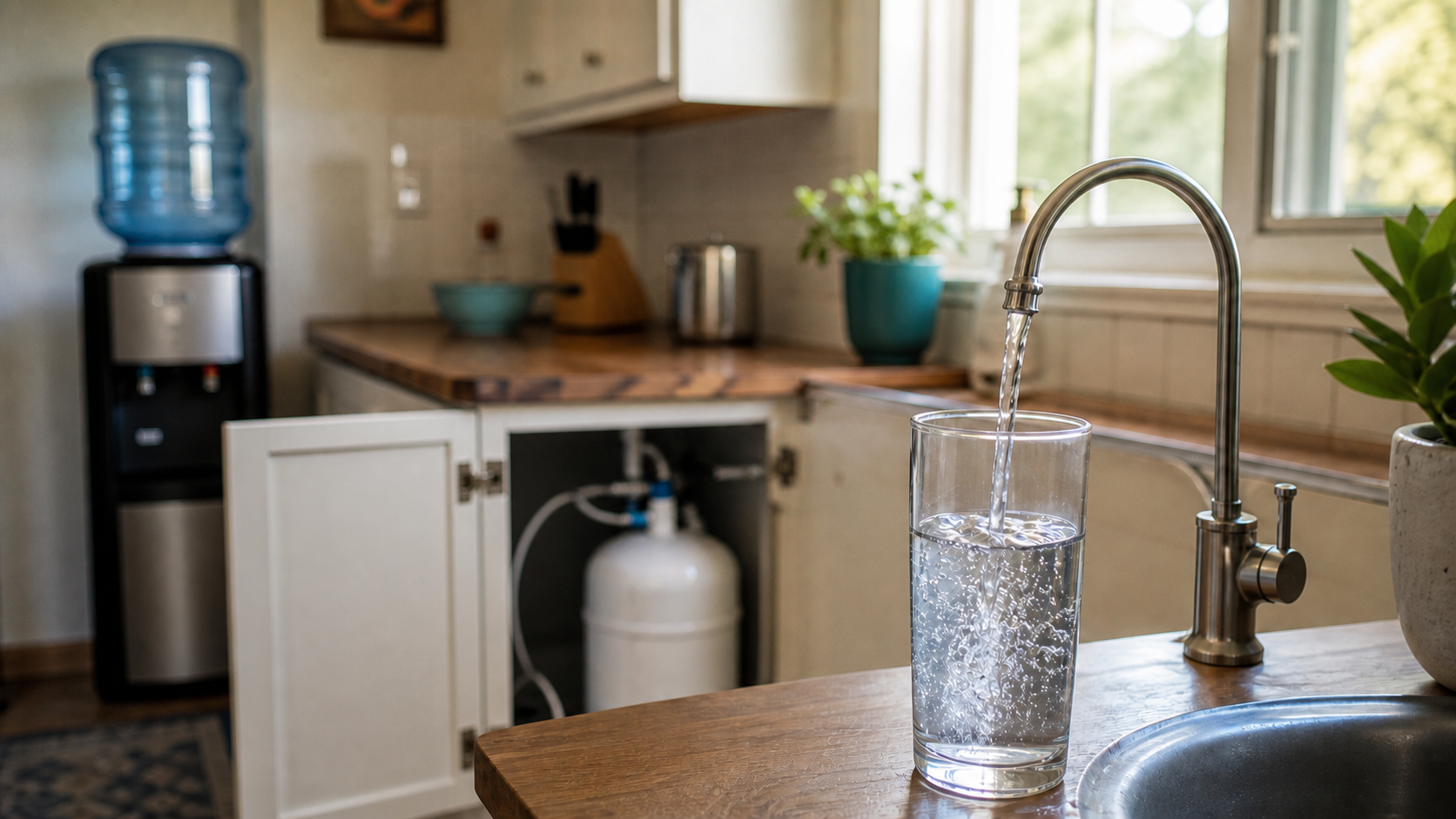
For years, getting “better” water became a small part-time job.
I had five-gallon bottles delivered. Later, I drove my own empty bottles to water-dispensing stations, filled them, loaded them back into the car, and carried them home. Eventually I subscribed to an under-sink reverse osmosis system with four or five filters and a storage tank.
That felt like the final answer. Turn the little faucet, get purified water, stop hauling bottles.
Except the faucet did not always have much water to give. Once the tank ran low, I had to wait while the reverse osmosis system slowly made more. I also could not open the tank and see inside it, much less wash it like a water bottle. Maybe it was perfectly maintained. I simply had no satisfying way to know.
Then I learned something I should probably have asked much earlier: Does reverse osmosis remove minerals from water, too?
THE SHORT ANSWER
Yes. Reverse osmosis can reduce many dissolved substances, including calcium and magnesium. That does not automatically make RO water unhealthy—but it can change the water’s mineral profile and taste.
The water was purified. Why did it taste like almost nothing?
Reverse osmosis works by pushing water through a membrane that rejects many dissolved substances. That is why RO can be useful when the source water contains something you specifically need to reduce.
It is not very sentimental about what passes through, however.
The CDC lists calcium, magnesium, potassium, sodium, chloride, and sulfate among the substances an RO system may reduce. Exactly how much depends on the membrane, system, water pressure, maintenance, and the water entering it. So “RO removes all minerals” is too absolute. RO commonly removes most dissolved minerals is the more accurate idea.
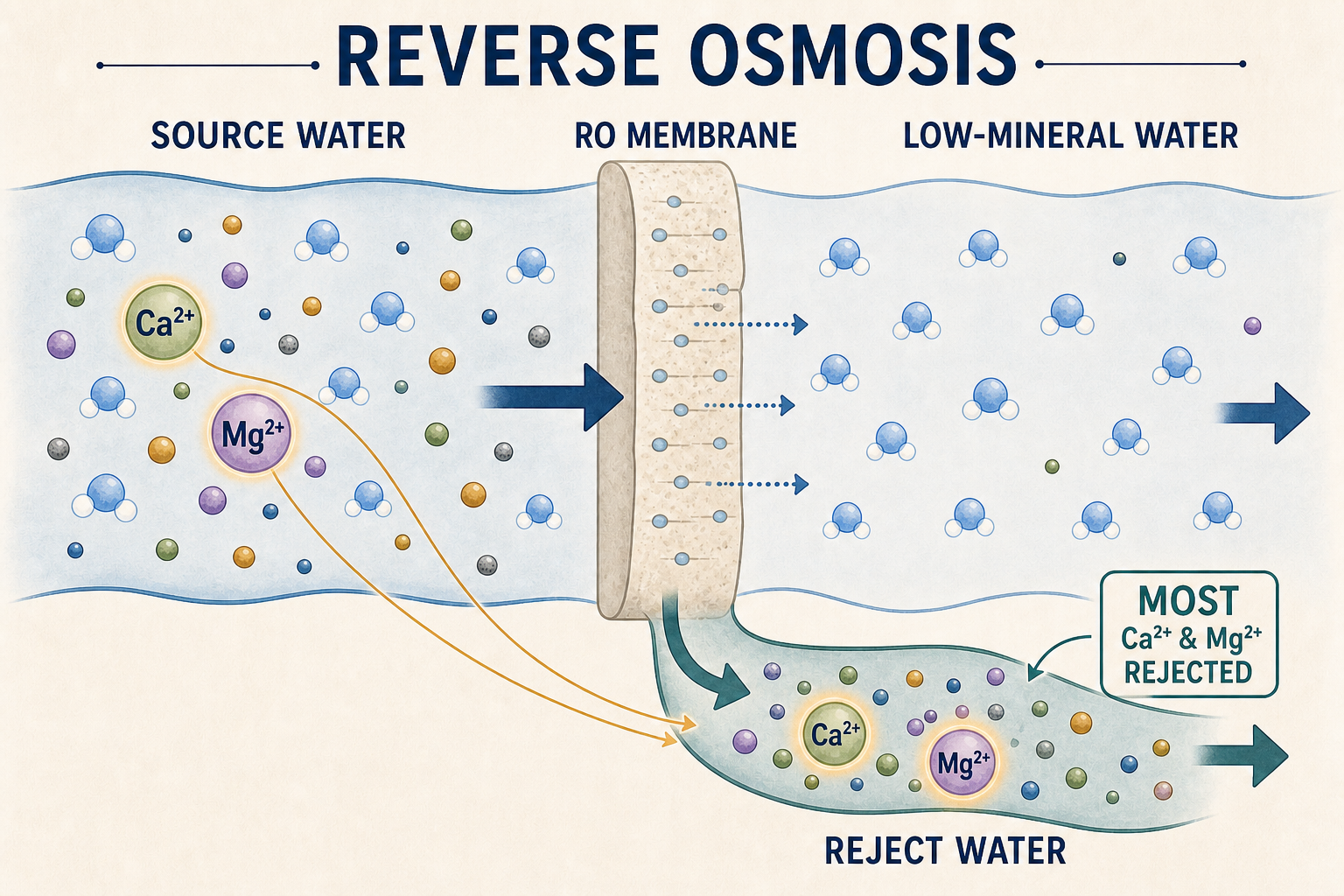
An RO membrane reduces many dissolved substances along with target contaminants. The result is usually low-mineral water—not a defensible promise of absolute zero.
That tradeoff can show up on your tongue. Research on drinking-water taste has found that mineral composition affects sensory quality. Water with very low mineral content is often described as flat, while different combinations of calcium, magnesium, bicarbonate, and other dissolved substances can change how water tastes.
This does not mean more minerals always equal better flavor. Too much of a mineral—or the wrong balance—can taste unpleasant. But it explains why two glasses that look identical may not taste identical.
My extremely unscientific blind test
I eventually tried an Amway eSpring purifier, which uses a carbon filter and UV-C LED treatment rather than reverse osmosis. The current system is designed to let dissolved minerals such as calcium and magnesium pass through while reducing specific contaminants. Its certified reduction claims should be checked by model in the current NSF listing, not assumed from the brand name alone.
Disclosure: I’m an Amway Independent Business Owner. This article contains no purchase or referral links, and I’m sharing my personal experience with the system.
I noticed the taste difference immediately. But that was hardly convincing evidence. I knew which glass came from which system, and people are very good at tasting what they expect to taste.
So I poured water for several friends without telling them which was which. Bottled water, RO water, and eSpring-filtered water went into ordinary glasses. This was not a controlled study: the group was small, the water temperatures and glasses were not laboratory-standardized, and nobody recorded scores on a clipboard.

Our comparison was informal and small. It was useful for noticing preference, not proving a health benefit or establishing a scientific ranking.
They still preferred the eSpring water.
That did not prove it was healthier. It did tell me that the difference was not entirely in my imagination—and that taste might matter more than I had admitted. The water I enjoy is the water I am more likely to drink consistently.
Does mineral-free RO water hurt your health?
This is where online discussion becomes dramatic very quickly.
You can find claims that RO water “does nothing for hydration,” strips minerals from the body, or is dangerous to drink. Those claims run ahead of the evidence. Water does not need calcium or magnesium in order to hydrate you, and most people obtain most of their minerals from food.
But the opposite extreme—minerals in drinking water never matter—is also too tidy.
WHAT WHO FOUND
The World Health Organization has reviewed calcium and magnesium in drinking water and concluded that mineral-rich water can make an incremental contribution to intake. How meaningful that contribution is depends on the mineral concentration and how much water a person drinks. A glass of low-mineral tap water and a glass of mineral-rich water are not nutritionally identical—even though neither replaces a decent diet.
My practical conclusion is less exciting than the internet’s: RO water is not automatically bad for you, but its mineral removal is a real tradeoff—not a myth.
After 40, do those minerals matter more?
Calcium and magnesium certainly matter as we age. Calcium supports bones, muscle function, nerve signaling, and blood vessels. Magnesium participates in hundreds of enzyme systems and helps with muscle and nerve function, blood-pressure regulation, glucose metabolism, and bone structure.
The recommended calcium intake increases for women beginning at age 51 and for men beginning at age 71. NIH guidance lists 1,200 milligrams per day for women ages 51–70, compared with 1,000 milligrams for men in that age range; adults 71 and older are listed at 1,200 milligrams. Adult magnesium recommendations are generally 310–320 milligrams for women and 400–420 milligrams for men.
Those numbers do not mean people over 40 need mineral water. They mean it becomes less sensible to treat mineral intake as an afterthought. Food remains the main source: dairy or fortified alternatives, leafy greens, beans, nuts, seeds, and other ordinary foods can contribute far more than most drinking water.
Water can be a supporting actor. It should not be handed the lead role.
The tank bothered me—but maintenance is the real issue
I disliked having a sealed RO storage tank under my sink because I could not inspect or hand-wash it. That discomfort was personal; it was not proof that my tank was contaminated.
What I later learned is more useful. The EPA recommends periodically draining an RO storage tank—about every two weeks—and notes that many manufacturers recommend sanitizing the tank annually. Filters and membranes also need replacement on schedule. Low production, low pressure, or an unexpected taste or odor can signal that the system needs attention.
In other words, a tank is not inherently dirty. It is a maintenance item that is easy to forget because it sits quietly under the sink.
My old system also had an everyday limitation no laboratory test could erase: it needed time to refill. The eSpring system treats water while it flows, so I do not wait for a small pressure tank to make another batch. In my kitchen, that difference is more useful than it sounds.
RO, remineralization, or a different filter?
There is no universally best filter because the right treatment depends on what is actually in the source water.
Is this exact system independently certified to reduce it?
Does the treatment allow the minerals already in the tap water to pass?
Would a remineralization stage help, and what exactly does it add?
Does the system treat water on demand at an adequate flow rate?
What must be replaced, drained, sanitized, or tested—and how often?
A remineralization cartridge can add selected minerals after the RO membrane. That may improve taste, but “remineralized” is not a complete specification. Ask which minerals it adds, in what range, how performance changes over the cartridge’s life, and whether any claim has independent certification.
The same skepticism belongs on every product page, including eSpring’s. Manufacturer language can tell you what a company claims. An independent listing, such as NSF’s, tells you which claims were certified for a particular model. Your local water-quality report or a certified laboratory test tells you which problems you may actually need to solve.
TRY THIS FIRST
Before buying another filter, look up your local water-quality report. Write down what you want to reduce, whether you care about retaining minerals, how much maintenance you will realistically perform, and whether you can tolerate a storage tank and slower recovery. Then compare certified claims model by model.
What changed my mind was not a mineral number
I began this whole process thinking “more purified” must mean “better.” Five-gallon delivery felt better than tap water. A dispensing station felt more controllable than delivery. A multi-stage RO system looked more serious than either one.
Now my definition is less impressive and more practical.
I want water that addresses the contaminants relevant to my water supply. I want a system I can maintain without pretending I will remember an invisible tank forever. I want water immediately, not after the tank catches up. And yes, I want it to taste good.
The minerals matter—but not because one glass of filtered water will rescue an inadequate diet. They matter because filtration always involves choices. Once I understood what my RO system was removing, “pure” stopped being the only word in the decision.
Taste brought the question to my attention. Maintenance made it practical. The evidence made the answer less dramatic—and much more useful.
Sources
- CDC: About Home Water Treatment Systems
- EPA: Treating Water With Less Waste—Reverse Osmosis Systems
- WHO: Calcium and Magnesium in Drinking-water
- NIH Office of Dietary Supplements: Calcium
- NIH Office of Dietary Supplements: Magnesium
- Water Research: The effect of mineral composition on drinking-water taste
- NSF: Current eSpring product listings
- Amway: Current eSpring system overview
Leave a Reply