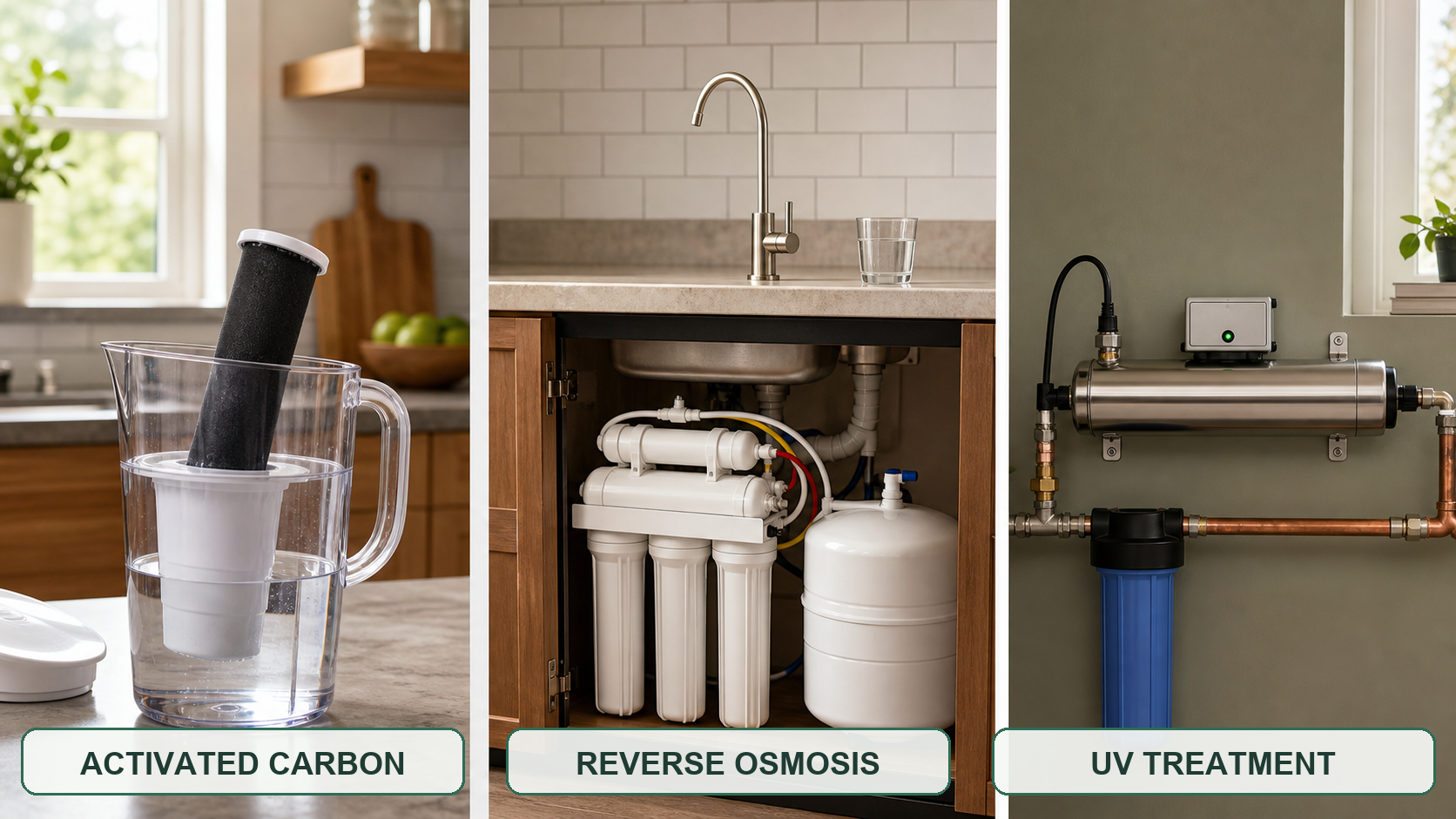
There is no universal winner. Reverse osmosis, activated carbon, and ultraviolet treatment solve different water-quality problems. RO separates many dissolved substances; activated carbon adsorbs particular chemicals and often improves taste and odor; UV inactivates microorganisms but does not remove dissolved chemicals or minerals. The right comparison begins with a water report or test—not a technology name.
“Reverse osmosis vs carbon filter” is often presented like a product contest. Add UV and the comparison becomes even less useful unless the target is defined. A filter that performs well against chlorine taste can be the wrong tool for nitrate. A UV system designed for microorganisms does not become a dissolved-chemical filter because it is another treatment stage.
- Adsorption
- Dissolved material adheres to the surface or pores of a medium such as activated carbon.
- Reverse osmosis (RO)
- Pressure moves water across a semipermeable membrane while many dissolved substances are rejected.
- Ultraviolet (UV) treatment
- UV light delivers a germicidal dose intended to inactivate microorganisms; it does not strain minerals from water.
- Point of use (POU)
- Treatment at one outlet, such as a kitchen drinking-water faucet.
- Point of entry (POE)
- Treatment where water enters the building, often called whole-house treatment.
Three technologies, three different mechanisms
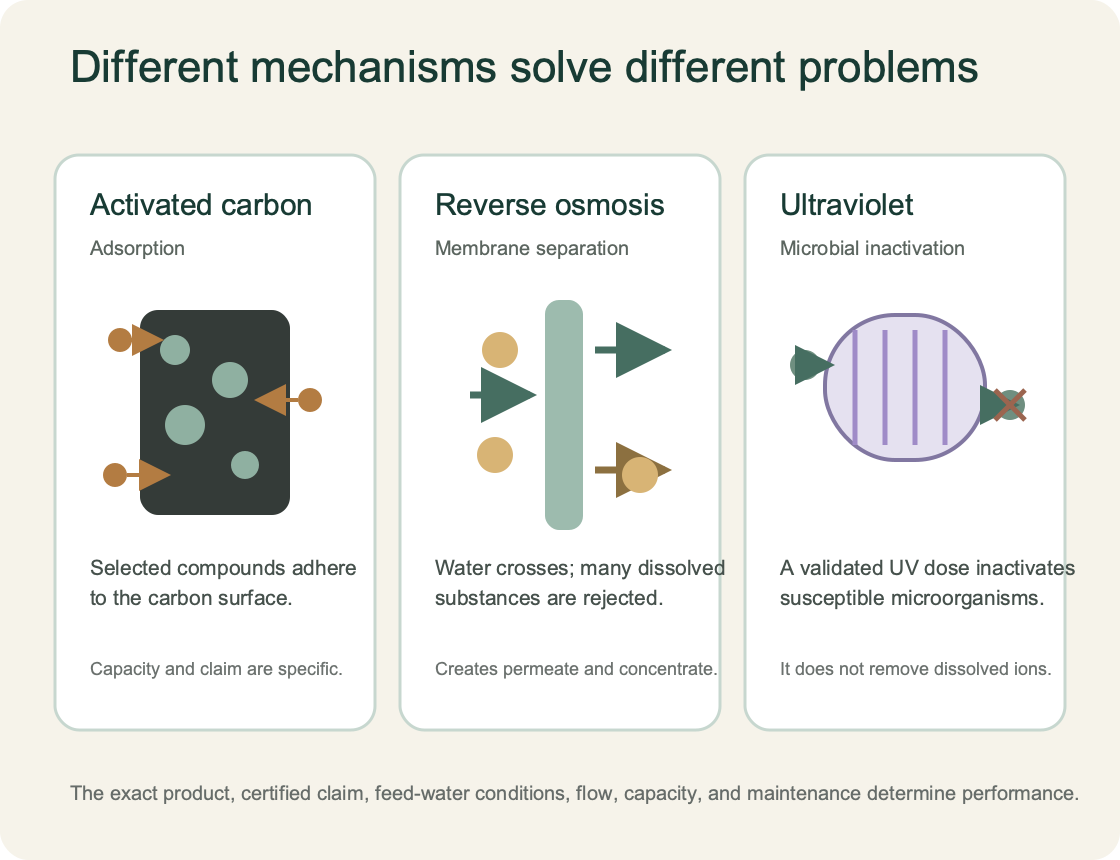
Adsorbs selected compounds
Often evaluated for: chlorine taste and odor, and model-specific organic-chemical or lead claims.
Does not imply: removal of every dissolved chemical or reliable disinfection.
Separates dissolved material
Often evaluated for: model-specific dissolved contaminants, salts, and mineral reduction.
Tradeoffs: reject water, membrane maintenance, pressure and flow considerations.
Inactivates microorganisms
Often evaluated for: bacteria, viruses, and cysts under the system’s certified class and conditions.
Does not imply: removal of chemicals, sediment, calcium, or magnesium.
Activated carbon: performance depends on the compound and the claim
Activated carbon has a large internal surface area. Certain compounds adhere to that surface, a process called adsorption. Carbon is commonly used to reduce chlorine-related taste and odor. Some carbon-based products also carry certified claims for specific contaminants with health effects.
The word “carbon” is not enough to predict performance. Carbon type, mass, pore structure, water chemistry, contact time, flow, and cartridge condition all matter. A small refrigerator cartridge and a large whole-house carbon bed do not have the same capacity merely because both contain activated carbon.
Carbon generally does not remove hardness minerals in the way RO or an ion-exchange softener does. That is why people searching for a water filter that keeps minerals often consider carbon-based treatment—but mineral retention says nothing about whether the unit addresses a separate contaminant of concern.
Reverse osmosis: broad separation with operational tradeoffs
RO forces water through a semipermeable membrane and produces two streams: treated permeate and concentrate. The CDC lists lead, copper, chromium, chloride, and sodium among the chemicals household RO systems can remove, while noting that they may also reduce arsenic, fluoride, radium, sulfate, calcium, magnesium, potassium, nitrate, and phosphorus. The label for the exact system remains decisive.
RO’s broad reduction is useful when the target is dissolved. It also creates costs that a comparison should show: concentrate water goes to drain, membranes and prefilters need replacement, production depends on pressure and temperature, and many residential systems use a storage tank because permeate production is slower than an ordinary faucet’s flow.
The EPA WaterSense report notes that conventional point-of-use systems can send several gallons to drain for each gallon treated, while WaterSense-labeled systems must meet efficiency and performance criteria. Waste ratios should therefore be checked for the specific certified model, not assumed from a generic RO estimate.
UV: disinfection without dissolved-contaminant removal
UV treatment exposes water to germicidal light. Properly designed systems deliver a validated dose to inactivate susceptible microorganisms. They do not remove dissolved chemicals, salts, calcium, or magnesium.
UV performance depends on more than whether a lamp or LED turns on. Flow rate, UV intensity, water clarity, sleeve condition, fouling, and the organism’s required dose matter. Suspended particles can shield microorganisms. That is why prefiltration and maintenance are not optional details.
NSF/ANSI 55 distinguishes Class A systems, intended to inactivate or remove microorganisms from contaminated water, from Class B systems, intended to reduce non-disease-causing bacteria in already disinfected drinking water. Those classes should not be collapsed into a generic “UV purified” claim.
Water-Treatment Starting-Point Selector
Select the problem you are investigating. The result identifies technologies commonly evaluated for that problem; it is not a product recommendation or a substitute for testing.
A combined system may be appropriate when more than one independently verified problem exists. More stages are not automatically better.
How to read certification without overreading it
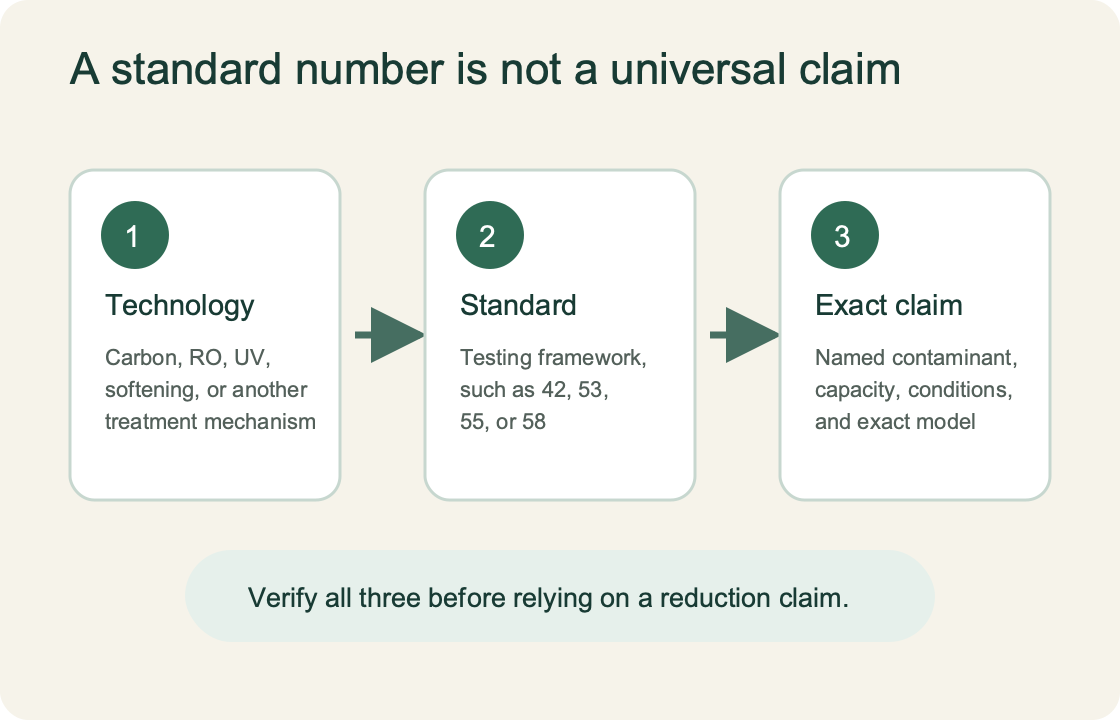
NSF explains that its standard numbers are not rankings. They identify different testing frameworks:
- NSF/ANSI 42: aesthetic effects such as chlorine taste and odor.
- NSF/ANSI 53: specified contaminant reductions associated with health effects.
- NSF/ANSI 55: ultraviolet microbiological treatment, with distinct Class A and Class B uses.
- NSF/ANSI 58: reverse-osmosis drinking-water treatment systems.
A product certified under Standard 53 is not automatically certified for every Standard 53 reduction claim. A product certified under Standard 58 is not automatically proven to remove every substance another RO model removes. Look up the model in the certifier’s current database and read the named claims, test conditions, capacity, and replacement requirements.
- The current water-quality report or appropriate laboratory result.
- The exact substance or microbial problem being addressed.
- The exact model’s independent certification and named reduction claim.
- Rated flow, capacity, feed-water limits, and maintenance schedule.
- For RO, efficiency and reject-water information; for UV, validated class/dose and status monitoring; for carbon, capacity and breakthrough-related replacement guidance.
Which system keeps minerals?
UV treatment does not remove dissolved minerals. Activated carbon commonly leaves calcium and magnesium largely unchanged, although a complete device may combine carbon with other media that behave differently. RO commonly reduces calcium and magnesium substantially. A post-RO remineralization cartridge can add selected minerals back.
That answer should not drive the entire decision. Retaining minerals is valuable only after the system’s primary job is clear. If a tested contaminant requires a treatment that also reduces calcium and magnesium, mineral retention may be a secondary preference. If the practical problem is chlorine taste in compliant municipal water, broad demineralization may be unnecessary.
The best comparison is therefore not carbon versus RO versus UV. It is identified problem → validated mechanism → certified model → maintainable system. Technology comes second, after the water.
Sources
- CDC: About Choosing Home Water Filters
- CDC: About Home Water Treatment Systems
- EPA: Overview of Drinking Water Treatment Technologies
- EPA WaterSense: Guide to Selecting Water Treatment Systems
- EPA WaterSense: Treating Water With Less Waste—Reverse Osmosis Systems
- NSF: Standards for Water Treatment Systems
- NSF: Home Water Treatment
Leave a Reply