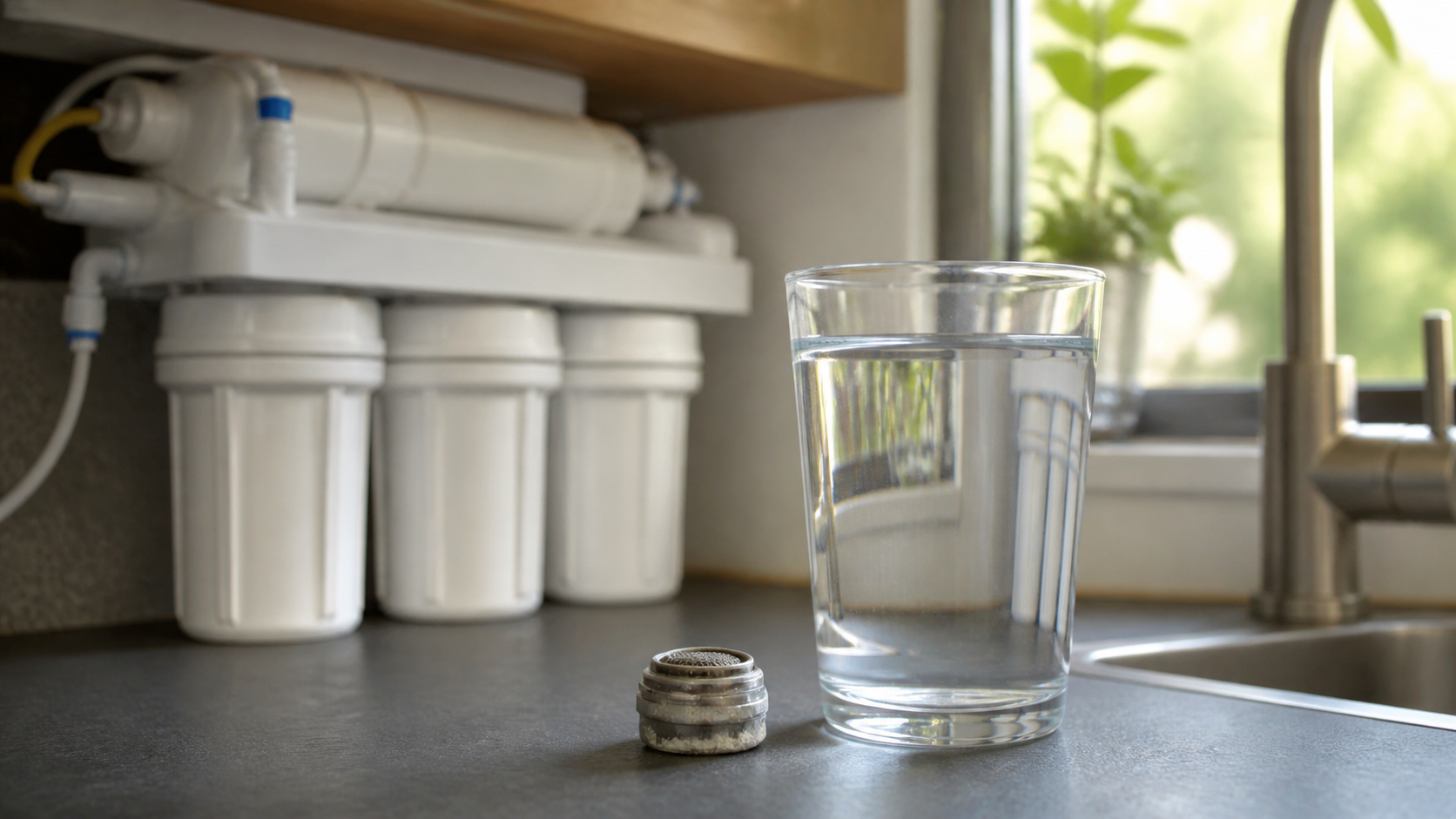
Short answer: Yes. Reverse osmosis commonly removes most of the calcium and magnesium present in its source water. The treated concentration is not necessarily zero, and the actual reduction depends on the incoming water, membrane, pressure, recovery rate, maintenance, and the complete system—not merely the letters “RO” on the label.
That distinction matters. “Does reverse osmosis remove calcium and magnesium?” sounds like a yes-or-no question. A useful answer needs three numbers: the calcium and magnesium concentrations before treatment, the concentrations after treatment, and the conditions under which they were measured.
- Feed water
- The water entering an RO system.
- Permeate
- The treated water that crosses the membrane.
- Concentrate or reject
- The stream carrying substances rejected by the membrane.
- Hardness
- A water-quality measurement driven mainly by dissolved calcium and magnesium.
- Total dissolved solids (TDS)
- An estimate of the combined dissolved ionic material in water. It is not a contaminant list and is not, by itself, a safety score.
What an RO membrane does to calcium and magnesium
Reverse osmosis uses pressure to move water across a semipermeable membrane. Water and some small dissolved material pass into the permeate stream. Much of the dissolved material remains in the concentrate stream and goes to drain.
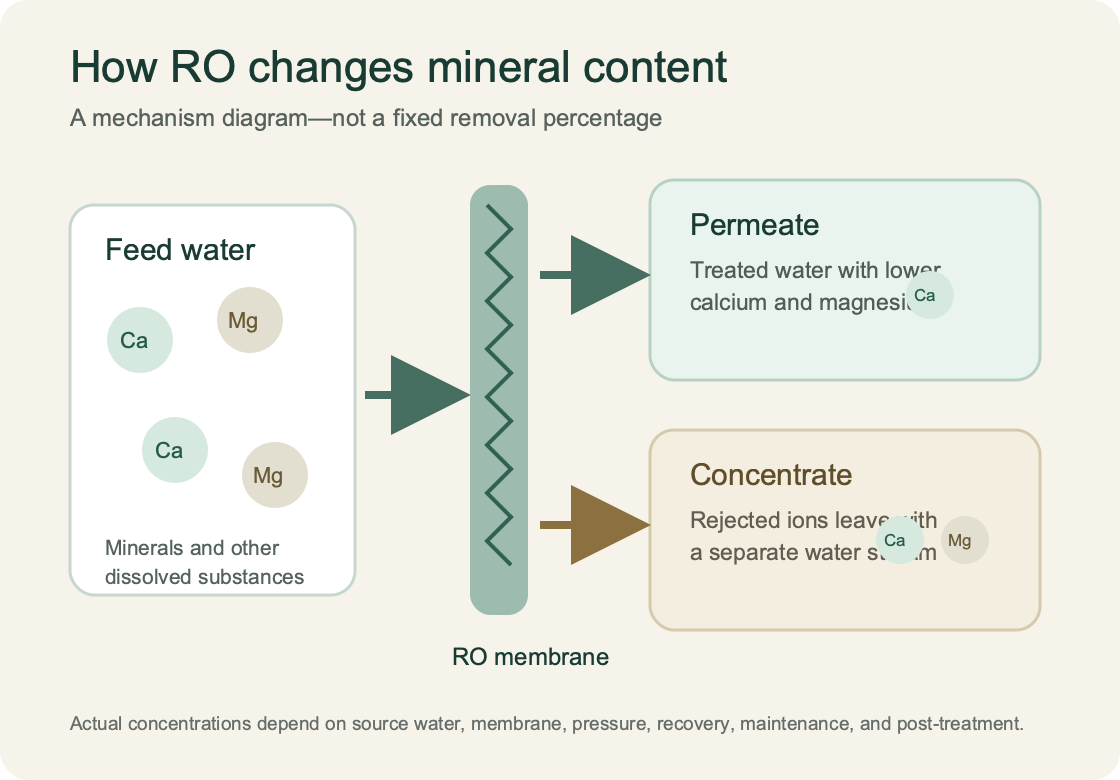
The Centers for Disease Control and Prevention says household RO systems may reduce calcium and magnesium, among many other substances, and tells consumers to check the exact system label. A World Health Organization technical review uses stronger language: a properly functioning point-of-use RO membrane can remove almost all calcium and magnesium in the source water.
Those statements are compatible. CDC is giving consumer guidance across many products and operating conditions. WHO is describing the expected behavior of an effective RO membrane. Neither source guarantees the result from an unknown unit under an unknown kitchen sink.
Why the removal percentage varies
Membrane performance is often summarized as solute rejection. If feed water contains 40 milligrams per liter (mg/L) of calcium and the permeate contains 2 mg/L, the observed reduction is 95%:
(40 − 2) ÷ 40 × 100 = 95%
That calculation is straightforward. Interpreting it is not. Temperature, pressure, membrane condition, mineral concentration, pH, recovery rate, leaks around seals, and the point at which a sample was collected can all affect the result. A post-filter that adds minerals back changes the final faucet sample even if the RO membrane itself is performing normally.
For that reason, a marketing rejection percentage and a sample from your kitchen faucet answer different questions. The first describes a product claim under specified test conditions. The second describes the water you actually received at that moment.
Use calcium and magnesium results—not TDS alone
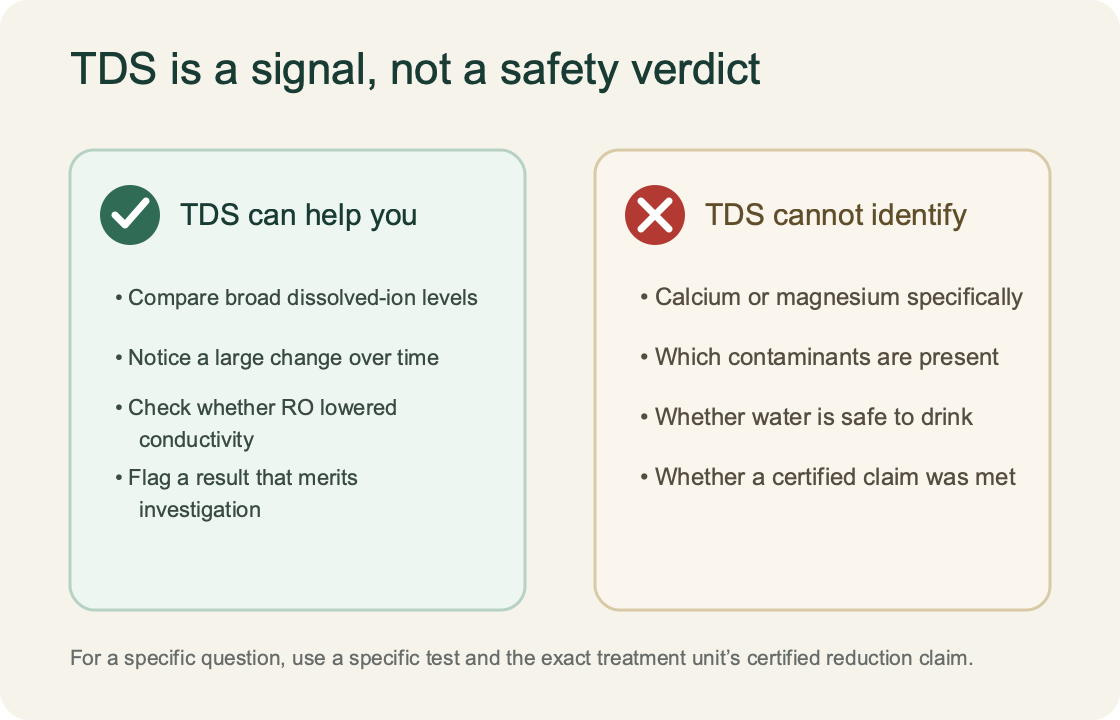
A handheld TDS meter estimates electrical conductivity and converts it into a total dissolved solids value. It is useful for noticing a broad change between feed and treated water or watching for a large performance shift over time.
It does not identify calcium, magnesium, lead, arsenic, nitrate, sodium, or any other individual substance. Two water samples can have the same TDS and completely different compositions. Water with a low TDS can still contain a contaminant of concern; water with a higher TDS can contain ordinary calcium and magnesium.
If the question is specifically about calcium and magnesium, obtain measurements for calcium and magnesium. If the question is about a regulated contaminant, use an appropriate certified laboratory and verify that the treatment unit carries a reduction claim for that contaminant.
RO Mineral Reduction Calculator
Enter matched before-and-after laboratory results in the same unit. The calculator reports the observed reduction; it does not judge safety, membrane condition, or nutritional adequacy.
Use samples taken close together, from clearly identified points, and reported in the same unit. A zero or missing “before” value cannot produce a meaningful percentage.
Does lower mineral content make RO water unhealthy?
Mineral removal is real. The health conclusion is less dramatic.
Calcium and magnesium are essential nutrients, and drinking water can contribute to intake when its concentrations are meaningful and consumption is regular. The WHO review emphasizes that the contribution varies widely by location and source. Some water supplies contribute little; mineral-rich water can contribute more.
That does not turn every glass of hard water into a supplement, and it does not establish that low-mineral RO water is inherently unsafe. Nutritional adequacy depends on the whole diet and the person, not on TDS or hardness alone. The scientifically defensible statement is that RO changes one possible source of calcium and magnesium. How important that change is depends on the original concentration, the volume consumed, and the rest of the diet.
What remineralization changes
A remineralization stage adds selected material after the membrane. It may raise pH, alter taste, or add measurable calcium or magnesium. But “remineralized” is not a complete specification.
Ask which media are used, which minerals are added, the expected concentration range, how output changes as the cartridge ages, and whether the final claims are independently certified. A cartridge that improves taste is not automatically a reliable nutrient-delivery system. Conversely, a reader who prefers the taste of remineralized water does not need to prove a medical benefit to justify that preference.
How to verify your own system
- Identify the sample points. “Before” should represent feed water; “after” should represent the final water you drink.
- Use the same units and appropriate methods. Calcium and magnesium are commonly reported in mg/L. Hardness-as-CaCO3 is a different measurement and should not be substituted without conversion.
- Check the exact model and claim. Certification to a standard is not a promise to reduce every contaminant covered somewhere within that standard.
- Record maintenance state. Membrane age, cartridge age, pressure, and any remineralization stage matter.
- Do not use taste as a safety test. CDC notes that harmful substances may not change water’s taste, smell, or appearance.
The search question has a clear answer: reverse osmosis usually removes most calcium and magnesium. The more useful follow-up is not “Are minerals good or bad?” It is “What was in this water before treatment, what remains afterward, and which decision am I trying to make with that information?”
Leave a Reply